

 It’s hard times for late stage advertising technology companies. Many public and private investors are gloomy on ad tech, and older startups needing new funds lately find themselves forced to choose between unattractive options, such as going public or raising money at a lower valuation, a painful event sometimes referred to as a “down round.”
These are problems Chicago-based agency workflow platform Centro, which hired Michael Bruns as CFO this week, has been blessed to avoid.
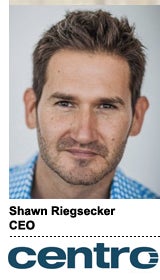
CEO Shawn Riegsecker said this is due to Centro’s relatively low cash requirements to date. The company’s only investments have been a $22.5 million Series A round completed in 2011.
But Bruns’ hiring shows the company has its eye on its future cash needs.
Bruns is well versed in SaaS-based companies, after running finance for two such companies and selling one of them (ClearTrial) to Oracle in 2012. Oracle, of course, is one of the top four strategic buyers in the ad tech space, alongside Adobe, Salesforce and Google – a fact certainly not lost on Centro management. The company’s previous CFO, Leo Brubaker, was named chief operating officer last year but the company has only just found his replacement. According to Riegsecker, the hire was time-consuming since Centro needed someone experienced in public capital markets as well as in private fundraising.

“We want to have every option available to us,” he said. “If the public markets stay open and ad tech is getting strong valuations, there’s a very good chance we’ll continue down a public path. To the extent that they’re not we’ll continue to operate the business on our own cash and define private funding options.”
Does “every option” include a sale of the business?
“Selling the company is not on our radar screen,” Riegsecker said. “Our goal is, unless the majority of the global advertising industry is using our platform to buy everything, then we haven’t succeeded in what we set out to do.”
While Centro has historically focused on automating the media buying process for guaranteed placements, it has lately begun to focus more on programmatic. Last year it bought demand-side platform SiteScout for $40 million. It is now integrating that DSP technology with its existing product suite, and aims to release a new platform that supports exchange-based buying by January 2015.









