Ashes to ashes, dust to dust, 3-letter acronyms to 3-letter acronyms.
Specifically, in this case, APIs to MCPs.
Model Context Protocol (MCP) is an open-source standard that connects AI systems to outside sources, like data warehouses and analytics platforms.
The rise of MCPs “reduces the time [needed] to build and connect to other parties,” which lessens the need for manual processes, said Mansoor Basha, CTO of The Marketing Cloud, a Stagwell-owned suite of tools for marketers.
On Tuesday, Infillion launched the Infillion Agent Connector, a fully agentic media execution platform built on MCP. Within the connector, AI agents can communicate with each other and handle the full cycle of a campaign, from campaign planning and budgeting to targeting to analysis. Stagwell is among the early customers.

Building on past success
The Agent Connector provides an MCP so LLMs and AI agents can work across Infillion’s APIs without requiring an API-to-API connection. Through the integration, an MCP connects various agents throughout the campaign cycle. One agent’s output, like a curated audience, becomes the input for another, such as a media execution agent targeting that audience.
The industry is “exiting a programmatic era” and entering an agentic one, said Jeremy Woodlee, GM of enterprise at Infillion. But that doesn’t mean all the tools have to change.
When digital media shifted to programmatic, Woodlee said, “it’s not like we ditched all the infrastructure of the prior era.” Those former standards became the foundation of the next. An SSP might become a seller agent and a DSP a buyer agent, he said, but the needs for supply, measurement and optimization won’t change.
What will change, he said, is that brands and agencies will develop their own, individual agents trained on brand data and campaign history.
The Agent Connector allows advertisers to bring their agents or use an off-the-shelf solution, but, regardless, the agents are connected to the MediaMath platform within Infillion, Woodlee said, where the campaigns are launched. For clients that have worked with Infillion and MediaMath in the past, historical campaign data is stored there, too.
The platform covers “the full cycle” of an advertising business model, said Infillion CTO Simon Asselin, with agents handling each step of the process via natural language prompts. The advertiser can ask the agent questions like where to focus their budget for an upcoming campaign or why a certain campaign performed better than another. From there, the agent generates responses based on prior data and analysis.
The spice of life
Since the top AI tools are “one-upping each other pretty regularly,” Asselin said, the platform is currently AI-agnostic. Infillion doesn’t want to “develop a dependency” on one of them, he said.
Instead, if an agency wants to change up which AI is used in its chat interface, that team can simply swap out the model on the back end. The connector itself won’t have to undergo revisions.
The new “agentic flow,” as Basha described it, means that advertisers don’t need to learn how to use dozens of tools and platforms, because those processes have been standardized and can happen through natural language prompts, rather than needing coding chops or platform experience.
Stagwell, for example, doesn’t plan to only work with Infillion, despite using the new Agent Connector. As more companies develop fully agentic marketing platforms, Basha said, “we want to do this with everybody.”
Different companies’ tools will “have their own nuance,” said Basha. Some might excel at generating creative, while others might have wider arrays of inventory.
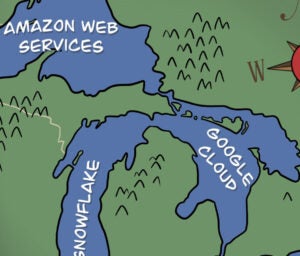
Infillion believes that its composable model is its most distinguishing feature, meaning the platform can be individually customized to fit a customer’s needs and can be natively deployed in whichever cloud, tech or media environment the customer prefers.
(Do you warehouse your data in Snowflake, use a third-party solution for identity data and then another vendor for marketing attribution? Keep doing what you’re doing, wherever you’re doing it. That’s composability.)
And it poses an alternative to advertising within walled gardens, where advertisers lack control over the tech, or on the open web, where they can use various tools but lack a centralized platform.
The online ad industry has “a lot of standardization,” said Woodlee. But every media or ad tech company has a slightly different offering and things they do “better or worse.”
One of the upsides of competition in the space, Basha said, is that each company must constantly innovate and improve to stand out. Which, he added, ultimately benefits their clients, too.