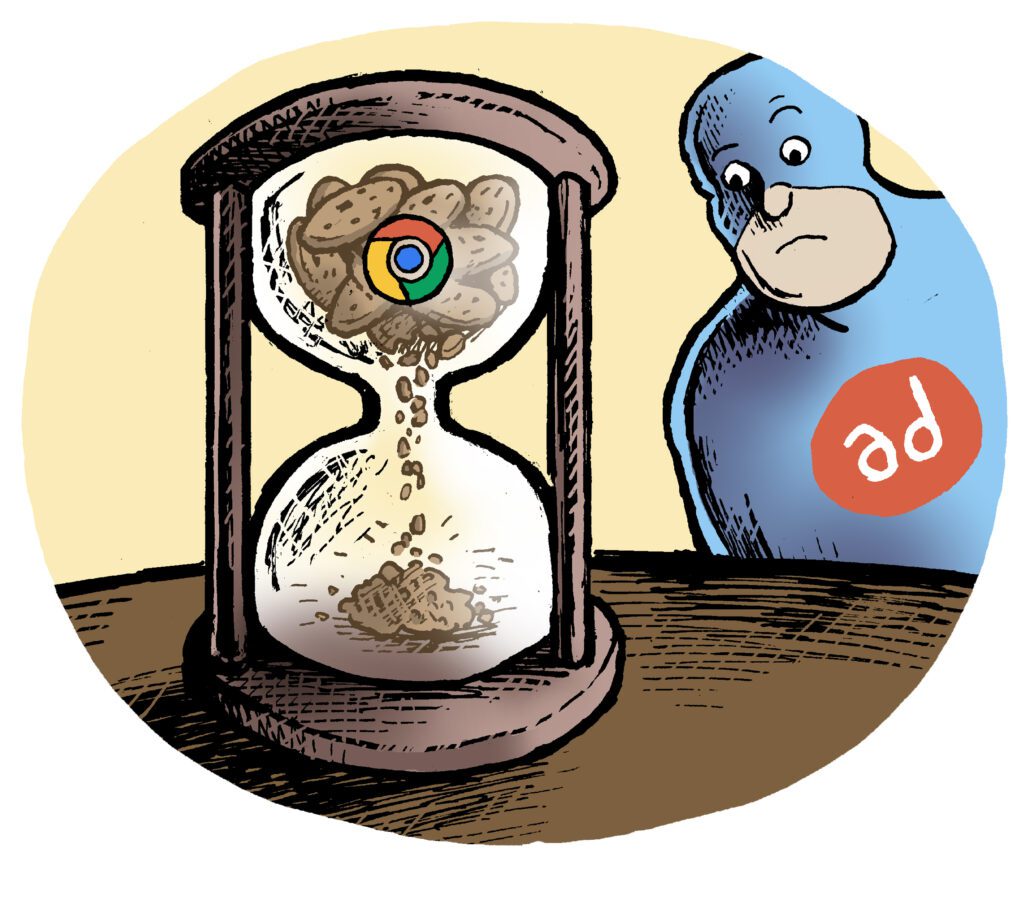
The prolonged phaseout of third-party cookies on Chrome lends itself to simile.
You could compare it to changing the wheels on a speeding bus or swapping out the engine of an airplane in flight.
Or you could say it’s like moving to a new neighborhood and hoping it’s nicer than the last place you lived, said Ana Milicevic, a principal at Sparrow Advisers, speaking at an identity-focused event hosted by ID5 in New York earlier this week.
Getting ready for the end of third-party cookies is also not unlike forcing people who aren’t friends to trust each other enough to all jump into a lake at the same time while holding hands, said Mathieu Roche, CEO and co-founder of ID5.
“It’s like being on heroin and changing to methadone,” someone called out from the audience.
That’s certainly one way to put it.

This is not a test
Despite their perilous position, some companies are still taking a “rather lackadaisical approach” to planning for post-cookie identity, Milicevic said.
Coupled with the shortness of the timeline, it’s like they’re “hitting the snooze button,” she said. And when the alarm goes off next July or August, people who aren’t ready will have a rude awakening.
Barring action by the UK’s competition authority, which has oversight of the Chrome Privacy Sandbox, the phaseout of third-party cookies finally appears to be on track for 2024 – coming at you like the slowest-moving freight train.
The testing of alternative identifiers has also been a slow process. There are a few reasons for that.
For one, if cookie replacements aren’t as readily available as the drug they’re replacing, it’s not easy convincing companies to move away from more familiar signals.
“Orchestration is challenging when you have quarterly targets and you still have to keep making money somehow,” Milicevic said.
Not ‘it’
But there’s also the question of times and resources.
Companies, whether they’re on the buy side or the sell side, know it’s important to start preparing – and that if they’re only getting started now, they’re already late.
The lack of testing isn’t because companies aren’t concerned, though.
You’d be hard-pressed to find an advertiser or a media seller that doesn’t care about maintaining addressability when third-party cookies go dark on Chrome. They just aren’t earmarking the people and the money to run the tests.
“[It’s] 98% about figuring out which team in your org is tasked with actually implementing this and which budget line that comes from,” Milicevic said.
“As much as we’d all like a blanket innovation budget,” she added, “that doesn’t exist.”
ID5 has experienced that phenomenon firsthand when it has called on brands and publishers.
“No one has ever told us, ‘This doesn’t make sense,’ or that they don’t agree with the vision,” Roche said. “They just say they’re not ready yet, that they’re waiting to see what will happen.”