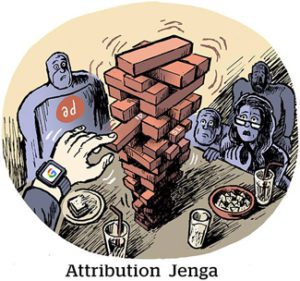
 Is this truly the end of last-click attribution?
Google will no longer use last-click attribution as the default conversion model in Google Ads, its buy-side ad network, the company announced in a blog post on Monday.
The change will mean that, going forward, the default attribution method for any conversion touchpoint – a new product purchase page, app install campaign, display ad landing page – will fall into what Google calls “data-driven attribution,” its algorithmic solution that assigns credit to different impressions over time.
Current conversion actions with last-click measurement will continue to attribute based on the final ad that drove a conversion. And last-click measurement will still be available.
Advertisers can toggle off data-driven attribution and choose one of Google’s five rules-based attribution methods: last-click, first-click, linear (which credits every impression equally), time-decay (credits by the duration between an impression and conversion) and position-based (40% credit each to the first and last impressions, and 20% spread over the rest).
“Rule-based attribution models, as opposed to data-driven attribution, are powered by fixed, static rules that assign credits to touchpoints,” Google VP of buying, analytics and measurement Vidhya Srinivasan told AdExchanger in an email.
Data-driven attribution is a live data model, so how the algorithm assigns credit will be different for every brand or campaign. The attribution scoring could change based on which sites or apps are contributing to conversions, or how consumer patterns change across browsers, apps and devices. The rule-based models are static; One might say stagnant.
But last-click does remain popular – the default until this day. It’s an intuitive model, especially for small and medium-sized advertisers that don’t use measurement vendors or set aside testing budgets.
Google hadn’t made data-driven attribution the default until now because in many situations it wouldn’t meet volume thresholds, Srinivasan said. Again, smaller advertisers see fewer sales, downloads or other conversions, and the product needs data coming in to work.

“Because of how we’ve been improving and training our data-driven attribution models, we’ve eliminated [that] previously existing requirement,” she said.
The change to data-driven attribution default also consolidates more ad spend – and thus more data – into one channel. Srinivasan said Google’s modeling has improved to the point that it can run data-driven attribution for any campaign type. But Google wants more and more advertisers to use data-driven attribution because the quality of Google’s data modeling is tied to the quantity of impressions and conversions it sees.
Modeled data will be even more important when third-party cookies are phased away, Srinivasan said. Machine learning can “compensate for gaps in data” if advertisers can’t effectively track customers or conversions, she said.
Data-driven attribution may not be more privacy-compliant than last-click, in and of itself. But in a privacy-forward environment where connecting ad impressions to online user activity is often prohibited, it will be the reliable methodology.
“To create the most effective and durable privacy-centric solutions, we need to continue to think about how we’re leveraging the data we do have as intelligently as possible,” Srinivasan said.