Local news consumption went through the roof during the height of the pandemic.
Haystack News, an ad-supported video-on-demand platform for news content, experienced that surge in demand firsthand.
The streaming service, which offers customized news packages aggregated across local, national and international sources with an emphasis on local, added roughly 3 million new users in 2020 and experienced its fifth straight year of more than doubling user growth. Haystack also doubled its number of demand partners over the past seven months.
Although Haystack does offer an ads-free option, it primarily monetizes through programmatic advertising, all of which is video. Haystack takes care of ad sales and delivery for its publisher partners on a rev-share basis.
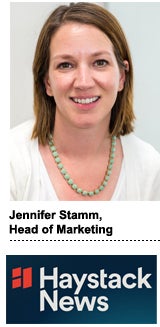
“We help news publishers surface and monetize their content, and we make it easier for people to consume local news in a connected TV environment,” said Jennifer Stamm, head of marketing for Haystack News. “If you look at how our world has changed – COVID-19, the protests, the upcoming election – local news is more important than ever.”
Stamm spoke with AdExchanger.

AdExchanger: What is Haystack News, in a nutshell?
JENNIFER STAMM: We’re a discovery platform that delivers a different kind of news-watching experience. We like to call our audience “information omnivores,” because they’re the kind of people who really value consuming news from multiple sources. They like to get different perspectives.
We help news publishers reach this incremental audience. For example, we can help local publishers reach audiences that are out of market and further monetize the news content they’re already creating.
It’s nice to hear that not everyone prefers living in an echo chamber. What are the typical demographics of your audience?
Our audience is actually representative of the demographics you see across the United States as a whole. We’re for people who prefer what you might call straighter news, who aren’t necessarily looking for opinion content or news analysis. And they value local news very highly.
What happened to consumption patterns during the pandemic, and how does that compare to now?
We were growing rapidly before the pandemic, but we did see a huge spike in March when people really started seeking out local news. We did see some drop-off after that, but it plateaued at a much higher level than our pre-pandemic consumption.
How exactly do you work with local news stations?
Take my hometown station in Lancaster, Pennsylvania, for example. They may not have the resources, tech team or ability to create apps for every CTV platform out there, but we can help them reach audiences on those platforms. We have a native app for just about every CTV platform you can imagine: Roku, Amazon Fire TV, Android TV, Apple TV, you name it. And we’re also available on LG, Hisense, Samsung, Sony and Vizio smart TVs. Basically, we make it easy for people to get their local news in all of those places.
We license the content from our news partners directly, and in some cases we’re able to take a local news segment and elevate to a national audience.
What is the rev share when you work with a CTV platform?
Our distribution arrangements vary on a platform-by-platform basis. We have close relationships with our app partners, both on the distribution side and on the news content or provider side.
What is the Haystack News experience like?
It’s a bit different than what you might be used to from turning on a new channel. The first time you open the app, we ask what you want to see in your daily headlines. You can choose from multiple categories – current events, entertainment, business and finance, international and so on – and also select your favorite news sources across local, national and international. And there’s also the option to follow hashtags for trending topics you’re interested in.
You set your location, but you can easily change it if you want to see news from other places. For example, you might set it for New York, because that is where you live. But you might also want to switch and see what’s happening in your hometown.
And then we create a custom newscast for you where we aggregate news segments from all of the different providers and publishers into one steady stream that you can consume in a lean-back way. We also have live event coverage, and dedicated channels for specific topics that aggregate news from sources like Cheddar and Yahoo Finance, plus you can also create your own channels for trending topics. At the moment, we have a channel dedicated to coronavirus news, for example, and one that’s just about the US presidential election.
Are there other personalization features?
We recently rolled out an interactive personalized news ticker called Newsline which is based on the concept of a news ticker that people know from watching cable TV, but reimagined for the CTV environment. We launched it on Roku at the end of May.
When a news ticker runs on a national network, everyone sees the same ticker. But the Newsline ticker varies based on the categories you follow and the topics and sources you selected. It’s built on the fly for each individual user and if you see a headline you’re interested in, you can hit the down button on your remote, click play and we’ll pivot you straight into that story.
AVOD versus SVOD: Will there be a winner?
Subscription fatigue is a thing, which is why AVOD services offer such an attractive proposition. Not everyone has the desire, or the ability, to spend money on multiple individual streaming services. That said, it’s not a zero-sum game. I think there is a place for both in this changing ecosystem.
This interview has been edited and condensed.