

 Carriers are looking for additional sources of cash (see the AOL/Verizon merger), and zeotap, a Berlin-based platform that helps mobile network operators monetize their data, is angling to capitalize on that need.
To do that, the company will use the majority of its $6 million in Series A, announced Tuesday, to fund international expansion into North America and double down on its engineering and business development efforts in India.
The round, led by Capnamic Ventures, Iris Capital and Prominent Angels, brings zeotap’s total funding to $7.3 million. The company first launched with $1.3 million in seed capital in November. Clients include Vodafone, O2 and Telefonica.
While the US and Canada are both top of mind for zeotap, the market in India is particularly ripe, said Projjol Banerjea, zeotap’s co-founder and chief product officer.
According to research released by Strategy Analytics, India will become the second-largest smartphone market in the world by 2017, surpassing the US and coming in behind China. For the moment, India’s smartphone market has a lot of room to grow, with penetration at about 19% among its 1.2 billion people.
Zeotap recently signed a deal with a large regional Indian carrier, and is in “advanced stages of discussion” with several others, although Banerjea declined to name names, citing NDAs.

“The numbers in India are not very large in absolute terms today, but there is a lot of potential there,” Banerjea said. “There’s going to be a rapid uptick in the sheer number of smartphones and operators are interested in making the most of the opportunity.”
The opportunity is clear – carriers have coffers full of rich first-party data at their disposal – but there are several stumbling blocks in their way if they want to activate it for advertising purposes, namely taxonomy, privacy and data leakage.
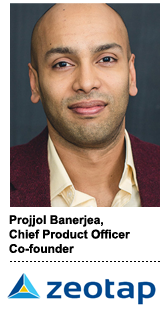 On the first count, zeotap’s platform helps convert a carrier’s data – which is generally used for internal business cases, like upsell and cross-sell – into something that the ad tech ecosystem can “digest,” Banerjea said.
Zeotap accomplishes that by matching user information with mobile identifiers like Apple’s IDFA and Google’s ad ID – which leads right to the privacy issue.
In order to avoid what Banerjea called a “regulatory nightmare,” zeotap strips out the PII, including email address and phone number. The anonymous identifiers they’re replaced with are “perishable,” lasting between 48 and 72 hours before they expire.
But building planned obsolescence into the IDs isn’t just about preserving privacy. It’s also meant to protect the value of a carrier’s data, Banerjea said.
“Most of the data in the ad market today is primarily probabilistic, but operators have deterministic data,” he said. “If they just release that kind of valuable user data into the ecosystem, they lose control of it.”
And control is one thing that operators are clearly gunning for, as evidenced by the $4.4 billion that Verizon shelled out for AOL in May. News of the deal broke while zeotap was in the midst of its fundraising process. But Banerjea isn’t worried about the 800-pound gorilla.
“Every VC asked us about AOL and Verizon, but we see it as a good indicator to the market of the telecom industry’s need to start diversifying their businesses with other revenue opportunities beyond data plans and voice,” he said.
Founded in 2014, zeotap has upped its headcount from 11 to 15 since November – a number Banerjea said the company hopes will reach 40 by the end of the year – and made several strategic hires, including Serge Bushman, who came on board in February as SVP of business development, fresh off a nearly two-year stint as director of strategy and new business development at Sprint-owned media platform Pinsight Media+.
Although zeotap’s official headquarters are in Berlin, going forward the company will focus on growing its presence in Bangalore, which has become a sort of Silicon Valley of the East. A New York office is slated to open its doors in about two months, followed by a potential outpost in Singapore, where Banerjea said zeotap is in negotiation with several Southeast Asia carriers.







