

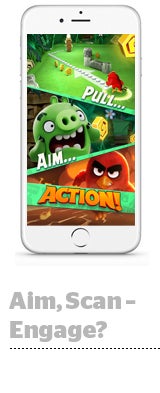
 A new game from Rovio Entertainment serves as the foundation for a sweeping augmented reality rollout to promote the upcoming “Angry Birds” movie, due out in May.
Rovio launched its campaign and the game, called “Angry Birds Action,” on Thursday.
It’s more than a one-off effort, though, said Alex Lambeek, chief commercial officer and EVP of consumer products at Rovio Entertainment.
Basically, Rovio will integrate QR code-like “BirdCodes” onto product packaging and point-of-sale kiosks with around 20 brands and retailers in more than 50 markets across the world, including Walmart, McDonald’s, PEZ and Lego.
At McD’s, for example, scanning BirdCodes unlocks a mini game within “Angry Birds Action” that will cause pig characters to pop out of the products, while codes on PEZ dispensers will let users fire PEZ candies at their pig nemeses. And at the end of the “Angry Birds” movie, the credits will contain an audio watermark that unlocks a new level in the game and an alternate film ending.
The question, of course, is whether consumers will engage and whether retailers will actually see an effect on sales.
There’s a lot riding on this movie launch for Rovio, whose prospects and finances have been shaky as of late. The game maker cut 130 jobs in October followed by another round of 260 layoffs in August. In 2015, the company had an operating loss of around $14.7 million, mainly because of heavy investment in the film project.
As with any emerging technology, skepticism is both healthy and sanity preserving. But AR isn’t really an emerging technology, per se. It’s been around in various forms since the 1960s. It’s also starting to weave itself into now ubiquitous and much-used experiences, like 3-D stickers and animated lenses in Snapchat. Most Snapchatters use AR every day.

And unlike virtual reality, with which it’s often lumped together, basic AR experiences (Google Glass aside) don’t necessarily require any additional hardware or gizmo, whether a $600 headset à la Oculus Rift or one made of cardboard. AR generally works through the phone.
But augmented reality has long been a “solution desperately searching for a problem to solve,” admitted Caspar Thykier, CEO of Zappar, the augmented reality platform Rovio is using to power its movie marketing push, and as a result, AR has been languishing in agency innovation investment limbo for some time.
“AR started to get interesting when it moved to mobile, but when technology goes from enterprise to consumer, it often gets caught in the agency trap of ticking the innovation box,” Thykier said. “It’s used for one marketing execution and that’s it. However, we’re starting to see businesses include it as part of their digital and mobile strategy.”
Rovio has a number of real KPIs for its campaign, including in-game user retention tied to in-store activity, in-store sales tied back to the BirdCodes and, naturally, movie ticket sales.
In the coming weeks, it’s also planning to benchmark and measure sell-through of BirdCoded items at participating retailers compared to products without codes and to retail partners who aren’t part of the initiative, so it can tweak its promotional plan accordingly.
“But the proof, of course, will lie in the pudding,” Lambeek said. “We’ll learn a lot over the next couple of months and we’ll see what we can improve.”
Rovio’s various “Angry Birds” games have been downloaded more than 3 billion times since the first “Angry Bird” title hit in 2009. The company declined to specify the number of monthly active users.









