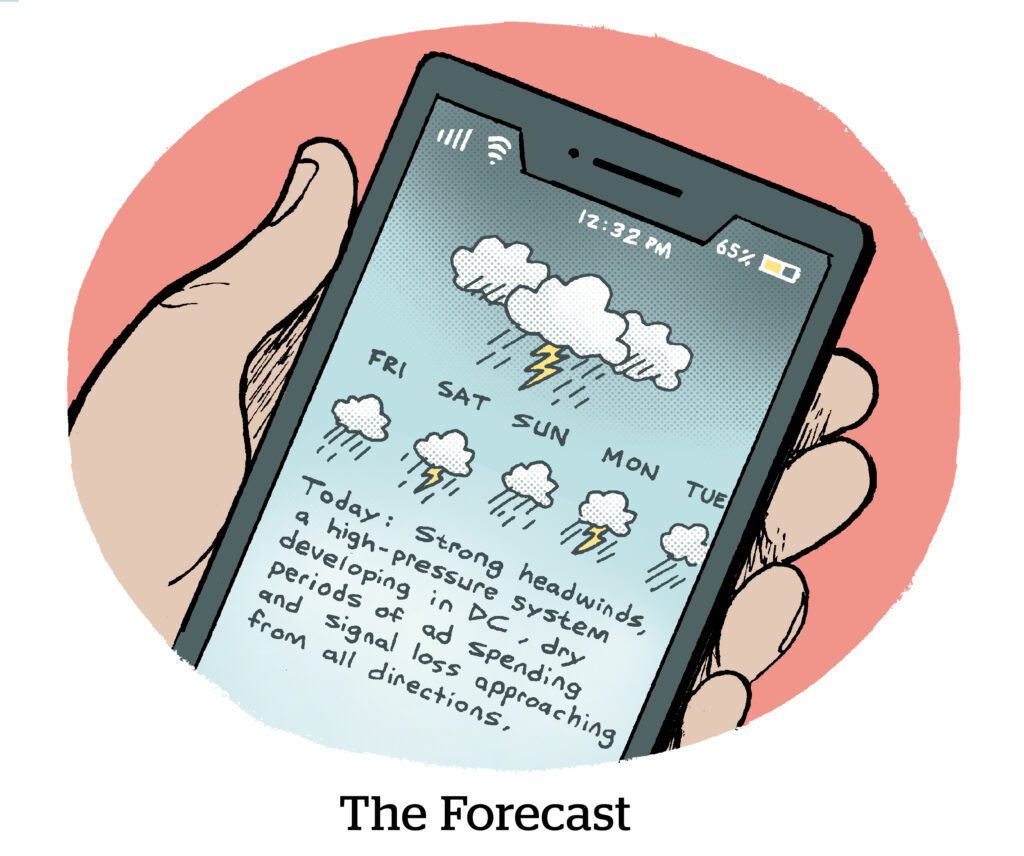
It’s a good day when an agency increases its annual ad spend forecast.
This week, WPP Media published its 2025 global end-of-year forecast, which predicts 8.8% growth over the past year (excluding US political advertising), a notable increase from the 6% the agency estimated back in June after new tariff announcements.
There are two main reasons behind the update, according to Kate Scott-Dawkins, global president of business intelligence at WPP Media, who previewed the results during a press briefing last week.
One is that negotiations lessened the impact of tariffs, and the other – you guessed it – is the AI boom.

Boom chicka AI boom
WPP Media segments ad revenue into four main categories: intelligence (search), commerce (retail media and travel and financial services), content (TV, social, gaming, etc.) and location (out-of-home).
The intelligence category was only introduced last year, but it made up 21.4% of global ad revenue in 2025, making it the second-largest revenue-generating segment (after content at 58%).
Those numbers are reassuring after a disappointing year for publishers, to say the least. WPP predicts that intelligence revenue will grow by about 10.3% in 2026 (pretty much at the same growth rate as between last year and this year), before – and here’s the less good news – decelerating through 2030.
Anyone still feeling optimistic should also know that WPP actually plans to expand its definition of intelligence in early 2026 to include AI search – meaning that the “intelligence” growth is partly because WPP is changing the definition.
Why didn’t WPP Media include AI search this year, though? It didn’t mince words.
“Perplexity’s ad revenue is insignificant,” WPP stated in its report, adding that once OpenAI introduces ads in ChatGPT, AI search is likely to become a more relevant player.
The search for search revenue
Taken together, these developments help explain how WPP believes search advertising – sorry, intelligence – will evolve over time.
It will be increasingly personalized, “pervasive across multiple surfaces and need states” and “proactive,” Scott-Dawkins said.
Search is shifting from a reactive channel, she said, where people type queries into a search bar, to a proactive one where relevant content is automatically suggested based on a user’s data.
WPP Media plans to announce a new framework for advertising intelligence at CES in January that scores companies based on factors including AI capabilities, content and data assets. It teased that Alphabet is already the “clear current leader.”
Looking ahead
The AI boom is also helping companies be more efficient with their manufacturing and product development, which allows them to reinvest their newfound savings into marketing activities, Scott-Dawkins said.
Not to mention the rise of entirely new companies, such as AI chatbots, that are becoming advertisers themselves, she added.
So why does WPP predict only 7.1% growth in 2026 and a drop to 5.9% by 2030?
There may be a hangover in price increases from tariffs that manufacturers initially mitigated or took on themselves, said Scott-Dawkins, plus the increase in age-gating and social regulation policies are likely to have a small but notable impact.
Plus, it’s hard to best the best.
“When you have comparable numbers as high as we are seeing this year,” said Scott-Dawkins, “those become harder to top the following year.”