The Grocery Dealbuster
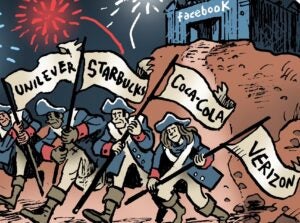
Antitrust regulation has counterintuitively favored the biggest ad industry players.
Of course, the grocery chain giants Kroger and Albertsons are hard to picture as the underdogs. Their merger was abandoned after a US District Court judge upheld the FTC’s injunction to block the deal. Albertsons ditched first and is suing Kroger for not doing its utmost, CNN reports.
But that’s little solace, as the two supermarket chains now must separately build ad businesses to contend with Amazon and Walmart (not to mention each other), which is brutally tough without scale across data and brick-and-mortar footprints.

Oh, and Walmart’s deal for the TV manufacturer Vizio, a major boon for its data and media business, glided by the FTC last week.
There are other examples, too. Consider US publishers: Many would prefer to band together to bargain collectively with platforms like Google and Meta for advertising and content licensing deals. But that would be an antitrust violation.
The merger of Outbrain and Taboola was likewise rejected because it consolidated two direct competitors into one – in antitrust terms, this is “horizontal integration,” and it’s why Amazon could buy Whole Foods but would likely meet opposition if it considered acquiring a second grocer, even a very small one.
We’re Relocating
Another streaming service, anyone?
NBCUniversal’s CNBC is launching a standalone streaming service early next year, Variety reports. The app will be called – shocker – CNBC+.
NBC parent company Comcast recently decided to spin off most of its cable networks into a separate public company. Its goal is to create distance between streaming gains and linear losses. Once CNBC is its own entity, for example, the network can use its revenue to invest in its own business growth, rather than feed into a giant corporation that’s more invested in streaming. Plus, once Comcast sheds some networks, linear declines will stop tarnishing its earnings reports.
Comcast isn’t the only publisher with this idea. Last year, Disney hinted at selling some of its local stations, including ABC affiliates. Disney has since denied those plans, even though it had preliminary talks with at least one ABC bidder.
Point is, linear is a loss leader that’s obstructing programmers’ stream dreams.
But will a standalone news service like CNBC+ actually take off? Or is it fated for oblivion like Warner Bros. Discovery’s failed CNN+ app in 2022?
Do I Stay Or Do I Go?
Combined, Omnicom and IPG will likely shed some clients.
OMG and IPG have a lot of direct competitors in their combined client pool: AT&T and T-Mobile; State Farm and Geico; Disney and Netflix. Four of these six brands inquired about potential client conflicts following the announcement, Ad Age reports.
Omnicom Chairman and CEO John Wren acknowledged the competitive conflict will drive some clients to rival agencies.
“Will it happen? Yes. But I think people will be short-sighted in doing that,” he said on an investor call earlier this week. Certain verticals, such as consumer-packaged goods and financial services, still try to avoid working with an overlapping agency or partner as their direct competitors.
Still, many marketers aren’t as sensitive to these conflicts as they used to be in the past, Ad Age writes. One reason is the rise of independent marketing consultancies with competitive intelligence like Deloitte and Accenture. Another reason is that many marketers likely have more pressing priorities. (Did someone say measurement?)
Ultimately, marketers will decide whether to stay or go based on how much they value their individual relationships with OMG or IPG.
But Wait! There’s More!
A federal judge rejected the sale of Infowars to The Onion, citing transparency issues with the deal. [Axios]
LinkedIn is the newest social platform to adopt a video feed for short, TikTok-style content. [Business Insider]
Donald Trump will replace FTC chair Lina Khan with the more “deal-friendly” Andrew Ferguson. [New York Times]
Meanwhile, Google wants the FTC to break up Microsoft’s exclusive cloud storage agreement with OpenAI. [The Information]
And speaking of Google, the EU is investigating its advertising practices regarding teens. [WSJ]
A brutally honest look at TCL’s attempt to make AI-generated movies. [404 Media]
YouTube is pushing to grow more on TV screens. [The Verge]
You’re Hired!
Hannah Buitekant has been named chief commercial digital and strategy officer of DMG Media. [Mail Metro Media]