Agentic AI is gaining popularity as a tactic for media buyers and sellers striving to simplify workflows, including in streaming TV advertising.
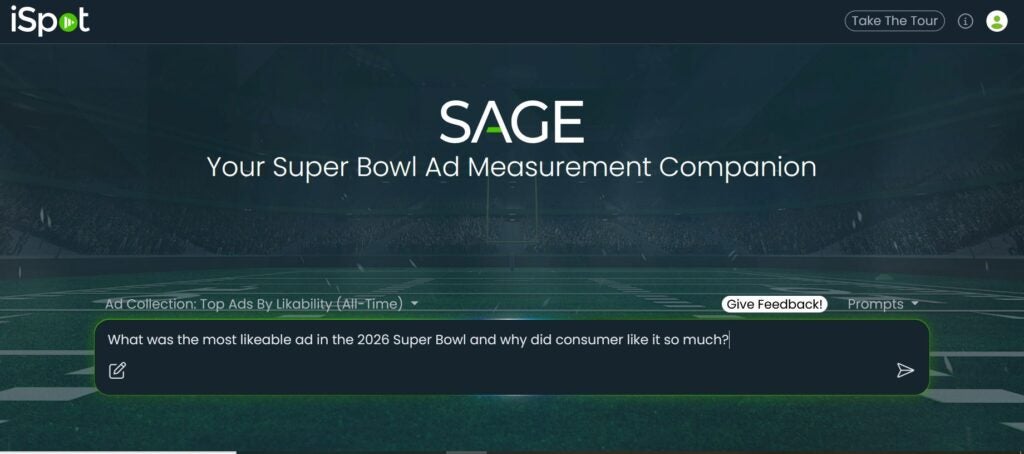
On Tuesday, the ad measurement firm iSpot introduced SAGE, an agentic AI platform with a “ChatGPT-like interface” that media buyers can use to generate campaign planning ideas, according to iSpot CEO Sean Muller. The platform includes separate agents for creative planning and performance analysis, along with features for competitive intelligence.
ISpot joins a growing list of ad tech companies launching conversational AI dashboards that let clients query campaign data directly, part of a wider trend to make media planning and measurement more accessible to nontechnical users.
With SAGE, iSpot aims to improve how the ad industry measures the effectiveness of ads, from the creative all the way to business outcomes, Muller told AdExchanger.
SAGE was two years in the making, and, late last year, iSpot launched it in private alpha with 12 brands actively testing it. These brands include Airbnb, General Motors and Balance of Nature, which is a whole food supplement brand with direct-to-consumer products, such as capsules and powders.
ISpot also introduced a Super Bowl dashboard for SAGE, which it made available to a select group of clients ahead of the Big Game on Sunday. The Super Bowl-themed view prompts buyers to ask the interface questions, such as, “What was the most likable Super Bowl commercial last weekend and why?” Because what better time to start exploring advertising success patterns than a cultural tentpole moment as massive as the Super Bowl?

SAGE’s wisdom
SAGE builds on iSpot’s outcomes-based measurement technology that assesses creative performance based on information such as surveys and ad placements. ISpot links that information to ad performance, which can include consumer responses, sales and other business outcomes.
Current measurement methodologies can give buyers a sense of whether or not their ads are having an impact, but “traditional dashboards” lack the ability to provide deeper understanding of why those ads are succeeding, Muller said. And brands need to understand exactly why their ads work to replicate that success.
To build SAGE, iSpot made an investment in Nvidia AI servers two years ago to analyze data and context from each frame of more than 2 million ad creatives. ISpot paired that information with its own data, including verbatim responses on consumer surveys, to create a framework that links ad performance with creative themes, such as family, active lifestyles and health.
The SAGE dashboard also boasts two separate AI agents: the Creative Planning Assistant, which generates creative recommendations, and the Creative Insights Analyst, which diagnoses ad performance. The infrastructure is what iSpot calls a “hybrid LLM model,” which means its agents have access to data from other large-language models, such as OpenAI and Claude AI.
But an important distinction is that SAGE can only tap data from OpenAI or Claude for information that can help it generate ideas about ad creatives and contextual themes or better formulate a response to a client. When it comes to any data related to the performance of an ad campaign, however, SAGE is instructed to rely solely on iSpot’s proprietary data, Muller said. That difference in data outputs is one reason why SAGE has two separate agents for ad creative and ad performance.
SAGE in action
For the brands tapping SAGE, common use cases include finding ways to expand audiences by ensuring its ads have the themes and placements with the best odds of resonating with new customers.
Balance of Nature, for example, recognizes that its customer base skews older and is looking for ways to widen its net. The brand’s core narrative is promoting awareness about phytonutrients, or substances found in certain plants that can help boost overall health and prevent chronic diseases in the long term, something that resonates with the older audience.
“We’re stepping out of our comfort zone with new theories and themes to test as we expand our core audience to be more family-centric,” said Kyler Blackmore, the brand’s media director. In other words, the brand is trying to feature more younger people in its advertising and place its ads in programming that younger audiences are more likely to see. (Which, Blackmore added, includes branching out further beyond Fox News.)
Balance of Nature plans to do this partly by tapping SAGE for more competitive intelligence. Conquest advertising, or a brand’s effort to siphon attention away from its competitor, is a backbone tactic of online advertising that’s becoming more popular across CTV environments.
Using SAGE, “we can test theories, themes and creative concepts from our own data sets as well as data sets about our competitors at a much faster rate than we have before,” Blackmore said.
For example, Balance of Nature discovered that its ads seemed to perform better when they highlighted themes such as happiness and physical activity. It may seem like “common sense principles” that ads featuring younger people perform well because they represent longevity, Blackmore said, but the only way to scale actionable insights is “being able to build really strong creative plans and test them quickly.”
In the near future, iSpot plans to incorporate more audience- and outcomes-based measurement into SAGE, although it didn’t share an exact time frame.
But, for now, buyers and brands are in the early innings of incorporating agentic AI into their streaming media plans.