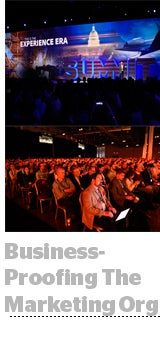
 Here at the Adobe Summit in Las Vegas, phrases like “change management” are getting nearly equal airtime as data and analytics.
Over the past 12 months, Marriott International has accelerated its tech investments as it blends digital and offline. To do so, it has needed to prove marketing strategies align with corporate objectives.
“We’ve been working to bring together our user acquisition teams and the Marriott.com teams,” said Andrew Haynes, senior director of digital personalization at Marriott International, onstage Tuesday. “Now we’re bringing in our loyalty team.”
Marriott’s loyalty team has used Epsilon for four years to support its email initiatives. More recently, that team has deployed a tag management system, data management platform, Adobe Analytics and website optimization tool Adobe Target.
The company also is in the process of implementing Adobe Campaign for campaign execution.
To break down barriers within its marketing organization, and ultimately increase investment in key technologies, Marriott’s marketing team needed approval from internal stakeholders. The team got it by proving small incremental gains that echoed corporate objectives.
“It really helped that we could collect data in real time off our site, show our executives we could build audiences in real time and, oh, by the way, ‘Here’s a cookie pool for a silver member who just searched for hotels in Chicago and here’s how it grew when we implemented third-party data,’” Haynes said. “It was making aspirational brand marketing more data-driven.”

These incremental proof points were critical as Marriott pursued more grandiose projects – like connecting digital to offline through proximity-based marketing.
In 2015, Marriott tested beacons at 12 hotel locations. Marriott would prompt loyal hotel guests to download its app if they hadn’t already and to opt in for location-based messaging via Bluetooth for special offers during their stay.
As a guest arrived at a property and the beacon pinged their device, Marriott would trigger relevant messages depending on their proximity. If they were in the lobby, they might get a personalized message outlining key services and amenities. If they were at the pool, they might hear about a special happy hour.
“We wanted to send real-time messages that would benefit their experience and stay with us, while we captured valuable data in return,” said Haynes.
Adopting these technologies and integrating them with the organizational workflow has gained notably more attention this year, according to Steve Jones, VP at Epsilon. Epsilon has been a partner to Marriott for several years on its loyalty and email initiatives.
“Whereas before, you’d see the focus on investments into individual point solutions, now you’re seeing brands eyeing key CRM integrations and offline data,” Jones said. “As you connect these technologies, the first question is, ‘What’s the impact on the business?’”
Often, the next step is identifying internal talent pools to own new projects and maintain ongoing employee communications for support as roles shift.
Macy’s People Process
Brick-and-mortar retailer Macy’s has faced its own struggles on the journey to build out its ecommerce presence. (The brand cut more than 4,000 jobs and closed 36 stores to cut costs following lower-than-expected holiday sales.)
When Shagun Aulakh, senior marketing manager at Macys.com, joined the brand three years ago, testing and personalization were in their infancy. The business had 15-plus decision-makers for every function, and reaching a general consensus on new ideas was close to impossible.
“Testing a new idea for the marketing team could take weeks or months, which meant our workflow to launch that idea was 22 weeks, which was almost half a year,” she said during a presentation at the Adobe Summit. “There was lack of alignment to company initiatives and politics superseded data.”
The biggest misalignment was that while Macy’s strategic business team emphasized the push to mobile, in reality measurement was limited to desktop and the ecommerce team didn’t take a data-driven approach to personalization.
So it created more of a centralized marketing unit – essentially the Macy’s “experimentation” team – which included governance and strategy, testing, analytics, systems, production and creative governance. One of its responsibilities was identifying ideas to blend offline and online channels.
In addition, the experimentation team created a support model where it “sized” all marketing needs by T-shirt size (small, medium, large, extra large).
“What business sometimes thought was a small project was really an extra large project where we’d have to pull in our CRM and data teams,” added Tony Hyde, senior solutions manager at Macy’s.
By setting realistic expectations around site tests and looking at more data through constant test-and-learn, the experimentation team was able to move the needle on personalization and reduce its workflow to a new idea from about 22 weeks to six to eight weeks.
Perhaps not surprisingly, the industry shift toward greater alignment of marketing with business objectives is mirrored in Adobe’s own product strategy for its Marketing Cloud.
The company has moved away from individual product updates to focus instead on supporting enterprise use cases and experiences.
“The chief experience officers in attendance don’t care about product names, they care about functionality and solving business problems,” said Brad Rencher, GM of Adobe’s digital marketing business, during a news conference.