

It’s not a news flash that advertisers aren’t happy about the effects of tariffs.
And they only expect things to get worse.
Forty-three percent of advertisers believe the business climate will further deteriorate over the next three months, according to an April study conducted by Advertiser Perceptions.

That’s the highest rate that Advertiser Perceptions has seen since they began asking respondents about business climate predictions in late 2022.
From 2024 through early this year, for comparison, that number fluctuated between 8% and 12%.
Tariff troubles
Within the first week or so after tariffs went into effect in late March and early April, 36% of advertisers reported seeing a negative impact on their business as a redirect result.
Another 27% said they hadn’t seen an impact yet but anticipate negative effects down the line.
On the other side of the coin, 19% of advertisers somewhat surprisingly said tariffs resulted in a positive impact on their business, and an additional 9% expect to see a positive impact in the future.
Why the discrepancy?
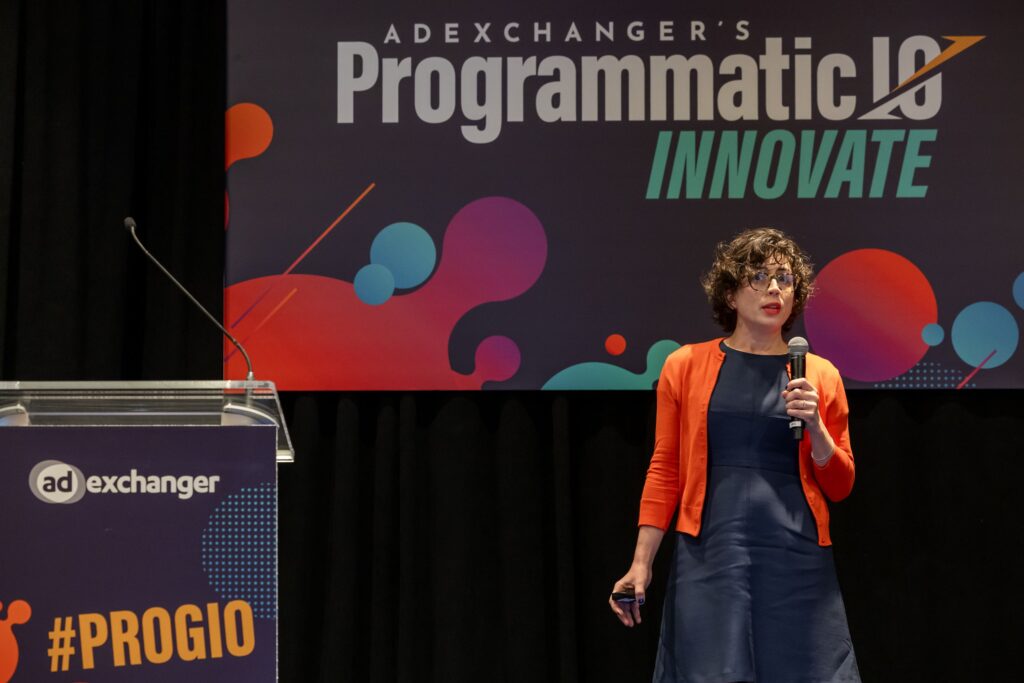
“Higher-margin legacy brands” are the ones seeing positive impacts, according to Nicole Perrin, EVP of business intelligence at Advertiser Perceptions, speaking at AdExchanger’s Programmatic IO event in Las Vegas on Tuesday. Those businesses, she explained, are aware that a lot of their competition is less profitable than they are and unable to absorb the tariffs.
In other words, legacy brands are out for blood, using their upper hand to continue expanding their market share.
Not all brands are created equal
Per the same April study, 25% of advertisers expect their ad budget to decrease in 2025, compared to 8% when asked in both December 2024 and February 2025.
But this isn’t true for everyone. The industry that a business operates in has a major impact on its financial security and is a big factor in its decision-making.
Fifty-seven percent of B2B marketers expect the business climate to improve by the end of Q2, and 50% actually plan to increase ad spending, compared to 16% of automotive and 14% of health care advertisers. The majority of advertisers in those categories expect to see the business climate deteriorate.
When asked why B2B advertisers were such outliers in the study, Perrin noted that Advertiser Perceptions hadn’t specifically asked B2B marketers about this trend, but she suspects that it’s related to the sharp increase of AI used in B2B marketing.
As companies are forced to downsize, she said, they’ll need to bring in new partners and AI tools so that both they and their customers can ultimately “do more with less.”









