

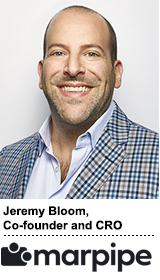
As ecommerce advertising becomes more expensive on Facebook, Jeremy Bloom, co-founder and chief revenue officer of tech startup Marpipe, said that brands need to take a data-driven approach to creative testing instead of relying on antiquated “spray and pray” A/B testing methods.
Marpipe was founded by 26-year-old CEO Dan Pantelo and last year launched an automated creative testing platform so that marketers and creatives can see which ads are performing best and why. Marpipe uses artificial intelligence to generate thousands of ad variations to determine which are the most engaging.
Bloom, 40, a former VP of sales at TubeMogul — which was acquired by Adobe in 2016 — left his post as North American lead at Adobe last month to join Marpipe.
“Essentially, Marpipe demystifies the concept of which ads work and why,” he said. “We’re bringing digital marketing back to the basics. Did my ads work? Why or why not? We need to stop complicating everything.”
Bloom spoke with AdExchanger about the company’s growth strategy and its potential for disruption in the direct-to-consumer and ecommerce space.

AdExchanger: What problem do you solve?
JEREMY BLOOM: Creatives and marketers don’t know why creative works well. With A/B testing, we only know which ads win but we never know why they win. Marpipe is a platform that gathers this new breed of data across industries at scale that then enables major performance advantages.
Creatives and marketers are way too siloed — creatives don’t have a workflow for ingesting actionable feedback from marketing data. We’re a creative API — Marpipe is an agnostic platform, we’re not trying to sell media — and we sit in between the brands in all their advertising touchpoints.
The possibility is that we can be the world’s first creative API that streamlines the ability to leverage creative learnings everywhere, similar to what Gong does for sales enablement or what Twilio does for messaging. Marpipe is taking the guesswork out of advertising creative.
How does Marpipe determine whether an ad is performing well?
Based on an advertiser’s primary KPI — purchases, leads, etc. — we rank ads based on statistically significant test results to showcase what’s moving the needle, such as an image, text, ad copy, or background colors.
Our intelligence shows advertisers what to avoid so they don’t waste their precious media budgets. In some cases, a yellow shirt with a “BOGO” copy might perform two times better than a blue hat with a “20% off” overlay for a spring fashion sale.
Why are more sophisticated data-driven tools for creators important these days?
There’s nothing that measures creative testing. Right now, everything is audience based, demo based, people based, and with the deprecation of the cookie — with third-party targeting being imploded — every advertiser is going to say, my creative matters, we should probably test that and see if our creative is resonating with our audience, instead of just spending money on bad creative.
If the copy isn’t in the right place, if the image isn’t in the right place, if the logo isn’t in the right place, we have the ability to change all of that around in real time and give insights, so brands and marketers don’t just sit there writing checks to media vendors without having any actual ROI.
What tech partners do you work with?
We are the preferred testing platform for Facebook and Instagram. We started off strictly social but we’re branching out. We are integrated with Adobe. And we’re having conversations with all the major DSPs and social platforms.
What are your plans for future growth?
We’re having Series A conversations, and our vision is to build out for streaming and for video. Future growth would be threefold: streaming video, more platform integrations and leveraging our Enriched Catalogs/Dynamic Ads product within the platform — a catalog feed-based dynamic advertising testing tool — which is our biggest growth mechanism at the moment.
How are you funded? And what’s your headcount?
We’ve got $2 million in seed funding. We’ve got Laconia Capital, Tribe Capital, MathCapital, and TIA Ventures as investors. We have nearly 20 employees and we plan to double or triple our headcount by the end of the year. One of our investors/advisers is ad tech luminary Greg Coleman.
What type of clients are using your solutions? And who would your ideal client be?
We have three different groups of clients. One is up and coming DTC brands looking to maximize on performance, the second would be agencies and consultancies, and the third is Fortune 1000 enterprise-based brands. We’ve got the top tier DTC accounts, including Ministry of Supply, Tophatter and Oxford Road. And then we’re doing a tremendous amount of enterprise sale, for example Segment by Twilio.







