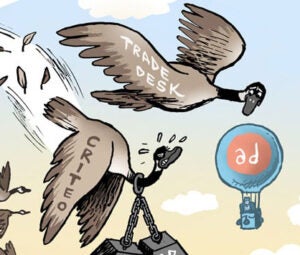
Identity chaos – that’s what a customer recently called the current state of identity management (or lack thereof). It became clear that the customer’s plethora of options, methodologies and use cases – all with their own trade-offs and a lack of interoperability – resulted in significant confusion and limitations.
With expanding consumer touch points and the adoption of omnichannel approaches, there can be no one signal to rule them all. Instead, each element plays a critical role, and the brands that can stitch together different approaches and signals to create order within the “identity chaos” deliver the most value.
The answer? Interoperable identity methodologies that work in parallel to drive meaningful outcomes – or “integrated identity.”


Integrated identity refers to the ability to link multiple inputs into a single, unified identity, enabling advertisers to recognize users consistently across various devices, apps, internal data sets and websites, while maintaining privacy and compliance with regulations.
Integrated identity forms a foundation for siloed data sets and identity spaces, improving personalization and reducing friction in digital interactions. This approach results in better targeting, streamlined user experiences and stronger adherence to privacy regulations like CCPA. And there’s no better time than now to embrace it.
Seven trends driving us toward integrated identity
1. Cloud and collaboration environments make it easier to connect data than ever. Collaboration is a hot topic in ad tech. Because most collaboration efforts are still restricted to straightforward data matching, the true value of collaboration and clean room technology comes when enhancements occur as the standard. These enhancements should include built-in hygiene, identity and enrichment options – reducing the friction and cost associated with expanding views of identity.
2. Marketing tech and ad tech are converging. Marketing technology is generally categorized as tools for optimizing marketing efforts (primarily to engage customers), and ad tech is categorized as tools for managing digital advertising (primarily to reach new audiences). These worlds are being forced together due to a focus on first-party data strategies and walled gardens built upon known customer data (e.g., login data).
3. This shift increases the need for marketing tech to translate into ad tech (from known to unknown) and for ad tech to get comfortable with marketing tech (handling personal data, for example). Integrated identity connects the marketing tech and ad tech landscape to a common framework, increasing interoperability and personalization options.
4. Tech stacks are converging, too. As the ad tech and marketing tech worlds are pulled together, there is invariably a scramble to own the end-to-end customer experience. Whether this refers to email service providers moving into broader activation or customer data platforms (CDPs) advising on identity, the race to be the “foundation” is on. And this means we need …
5. Stronger delineation between signal resolution, identity resolution and entity resolution. As technologies collide, there’s a growing need to align on what is being delivered. Signal resolution in a CDP is very different from full master data management-style identity management.
Linking an online ID to an email isn’t the same level of identity resolution as completing an entire customer and household record with deterministic data. These processes invariably serve different purposes, but we should expect them to converge in the next five years.
6. Clear lines between identity solutions built for addressability vs. identity resolution. Understanding what is being delivered leads to questions about the value identifiers provide. It’s vital that we clearly articulate the value as being either addressability or identity resolution – few achieve both today.
7. AI needs a truth set. As AI algorithms become more data-hungry, the quality of the data feeding these models is critical. Therefore, inaccurate customer data poses a significant threat that must be addressed with a highly accurate underlying truth set as the foundation.
8. AI delivers better interoperability. We’re approaching a new wave of identity interoperability, led in part by discovering new ways of creating matches and moving away from clunky, rules-based approaches to ones built upon mass-automated, self-learning experiments.
The future of integrated identity
As a new era of innovation approaches, customers should demand more transparency, greater control and increased flexibility from partners. This is the only way to navigate the current identity chaos that envelopes our industry.
It’s also the only way to maximize the opportunity presented by a mass volume of disparate identifiers and signals. To do that, we must move toward a view of integrated identity, where a strong, interoperable data foundation is king.
For more articles featuring Paul Turner, click here.