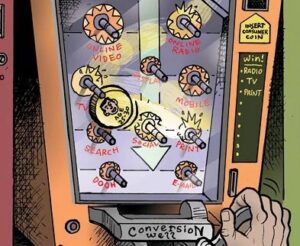

AI in advertising has gone from a buzzword to a full disruptor in what feels like just a few months. If CES was any indication, there is no sign of this slowing down.
Yet, although everyone’s talking, few are seeing real results.
New research from AdExchanger and Comcast Advertising found that 77% of advertisers agree that AI is transforming how advertising is bought, but a staggering 61% said they hadn’t seen a meaningful impact yet.
So, what gives? Let’s look at where AI is making a real difference.
Here are three real use cases showing how AI is driving innovation for streaming advertising:

AI makes buying live sports easier
Live sports and events are the gold standard for premium content, yet, when it comes to streaming, challenges remain, such as fragmented inventory across platforms, complex deal structures and limited real-time optimization.
Leading tech platforms have spent years building out capabilities to help the industry get live events right and ensure a seamless ad experience for viewers. For the first time, AI is allowing buyers and sellers to tap into this powerful programming in simpler, faster ways by enabling agent-to-agent transactions across both linear and digital platforms. What once seemed unimaginable – true agentic buying in the premium video marketplace – is now a reality.
The majority (60%) of the advertisers that Comcast and AdExchanger surveyed agree that AI is about improving efficiencies.
Now advertisers can harness AI to easily activate premium programming, such as live football playoff games, at scale in a way that preserves human expertise and resources.
AI helps reach audiences during impactful moments
AI is also unlocking innovations in how advertisers can reach valuable audiences. Today, 82% of advertisers say they use AI to identify or segment audiences, with the same amount using it to analyze audience behavior, the Comcast/AdExchanger survey found.
But efficiency in audience discovery only matters if the signals behind it are accurate and actionable. That’s where newer AI-driven technology is changing the game. Tools like semantic audience search use large language models to interpret the intent behind a query, moving beyond simple keywords to surface segments that truly match what an advertiser means.
A search for “young adults,” for example, returns relevant groups, such as ages 18 to 34 or recent college graduates, in seconds. AI-powered technology then ranks results by relevance, ensuring the most effective options rise to the top, while new CPM filters make it easy to identify segments that fit within the budget. Together, these advancements make audience discovery faster, smarter and more precise.
At the same time, as challenges such as signal loss, cookie deprecation and cross-platform fragmentation persist, AI and machine learning are helping transform video metadata into precise contextual signals. This enables advertisers to quickly identify the most relevant environments for their campaigns. Our research has shown that contextual alignment of program and ad content drives a more than 38% increase in brand recall.
By powering contextual analysis, targeting and reporting across direct‑sold and supply‑side programmatic deals, advertisers can plan and optimize with greater efficiency and accuracy and ensure ads reach the right audiences in moments that matter.
AI brings more performance insights to streaming
Measurement and attribution will be the biggest opportunities for AI this year. Agentic AI-powered solutions are turning hours of manual work into seconds of intelligent automation through the development of global agents that can help with intelligent media optimization. These tools empower buyers to manage campaigns in real time, simply by speaking or typing, bringing speed and precision to media investment decisions and driving performance.
The technology also goes beyond automation; it delivers actionable intelligence to help buyers streamline reporting, mitigate budget risks, ensure spend efficiency and track progress toward strategic commitments, which maximizes ROI and uncovers performance gaps in real time.
AI drives innovation for buyers
AI is unlocking innovation like never before when it comes to making buying more accessible and scalable. Yet adoption is cautious. Only 30% of advertisers today trust AI to do advertising tasks for them, signaling that credibility and control still matter as much as capability.
That tension will define the next phase of AI in advertising.
Advertisers will gravitate toward partners that allow them to integrate AI alongside their own proprietary systems, which helps preserve strategic control while reducing friction in execution.
AI’s role in streaming advertising is no longer theoretical; it is already reshaping how premium inventory is accessed, how audiences are discovered and how performance is managed.
But the technology will only move from buzz to backbone if it continues to prove its value in the moments that matter most. That is where the next chapter of innovation will be written.