Consumers today switch between screens and viewing interfaces to seamlessly view content. Now it’s time for advertisers to catch up to this convergence, so they can make ad experiences better, not worse.
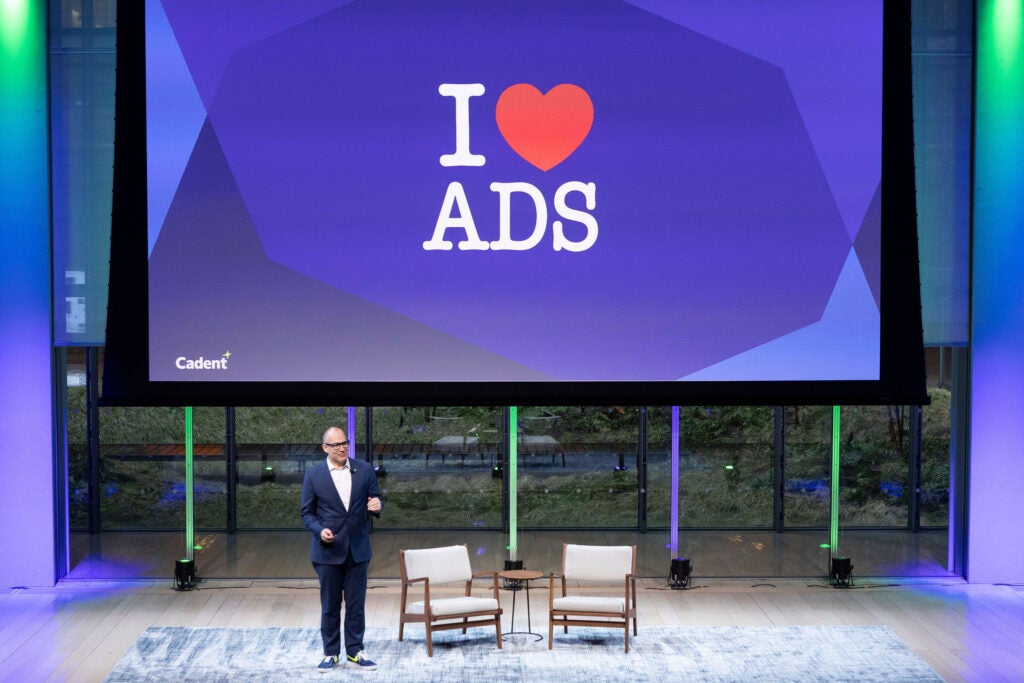
“Somewhere out there, someone watched an ad eight times in a single episode, they then saw that same ad three times across other platforms, maybe two more times across their television that night,” Cadent’s president, Doug Rozen, told attendees during the opening session of Convergent TV World in New York City on March 5th.
Ad repetition doesn’t win over viewers. They aren’t seeing ads through the same lens as marketers, who are impressed by metrics like reach or frequency. Instead, the viewers are annoyed by the same ad across platforms. “This is the change we need to talk about. This is the opportunity for the case for convergence,” Rozen said.
The issue with repetitive ads is excessive fragmentation. The ad tech industry criticizes walled gardens while building its own, Rozen said. Customers don’t think about whether they are watching linear TV or streaming TV; they watch video. “Their world is already converged.”

Consumers aren’t rejecting ads outright. “What they’re reacting to is the clutter, the notion of ads tracking them, the lack of relevance across all the screens,” Rozen said.
The fragmentation that already exists will worsen if we keep working in silos, Rozsen said. Interoperability should be the focus. Solutions that work together will simplify the experience for marketers and consumers alike, making the advertising experience better for everyone.
YouTube is much more than short-form video
One of the many viewing experiences marketers need to consider integrating into their total video strategy is YouTube.
During the session, “YouTube Is Now TV: Creating Your Total Video Strategy,” AdExchanger Senior Editor Anthony Vargas sat with Cadent Vue Planner EVP and General Manager, John Cobb, and Integral Ad Science EVP of Global Sales Carrie Seifer, to talk about how marketers can incorporate YouTube into their total video strategy.
Advertisers should consider video content holistically, even on platforms that may not first come to mind when thinking of “TV.”
YouTube is not always factored into CTV strategy, though it currently accounts for 12.5% of all video streaming on TVs. For comparison, Netflix viewership is at 8.8%, according to Nielsen’s monthly gauge report from January.
The type of content consumers watch on YouTube is changing, too. What was once a place almost exclusively for user-generated video has transformed, Seifer observed. It’s where consumers get a variety of content, including podcasts, music, gaming and sports. That change, along with its scale, makes YouTube impossible for marketers to ignore as a place to run video ads, she added.
“For marketers, I think the biggest challenge is not to look at [YouTube] as a channel or TV. It’s really a marketing platform. How do you use all those different content forms contextually to really drive outcomes for your campaigns?” said Cobb.
The popularity of YouTube as a place to listen to content like podcasts – a video platform delivering audio – “just shows the ease of getting started on YouTube,” Seifer added. “It’s something Google has always been good at, one little search box. I’ve admired and studied this simplicity of getting to the product so quickly.”