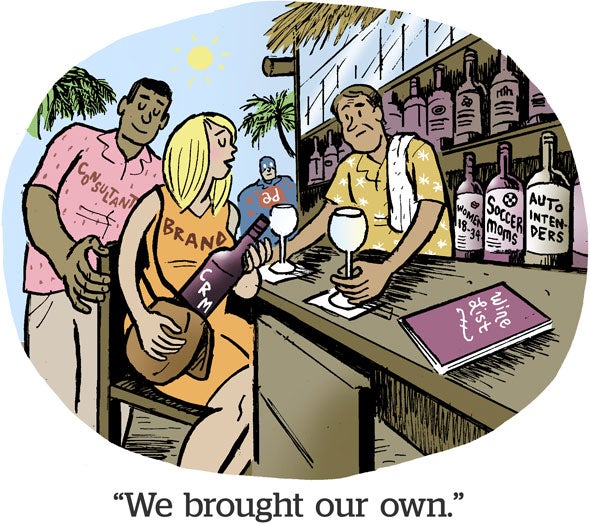
A booze brand and a “headless commerce” platform walk into a meeting with the CFO.
That might sound like the setup for a punchline, but it’s just how mar tech works these days.
Headless commerce is a system whereby multiple front-end media environments (social media, ChatGPT, a brand’s site, another app, etc.) connect to back-end fulfillment systems. Think Amazon or Walmart delivery, FedEx, DoorDash and buy-now-pick-up-in-store, to name a few.
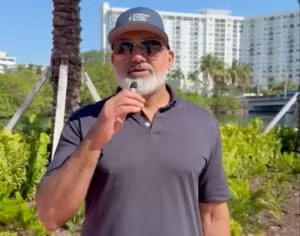
This type of site architecture is the way forward, said Nuno Pedro, global head of the Digital Center of Excellence at the Mark Anthony Group, an alcohol manufacturer whose brand portfolio includes White Claw and Mike’s Hard Lemonade.

Pedro is familiar with ecommerce marketing jargon, having joined Mark Anthony Group in 2022 from SAP, where he was GM of commerce solutions.
AdExchanger caught up with Pedro to talk about where he sees commerce media going next.
AdExchanger: Why move from SAP Commerce Solutions to an alcohol manufacturer?
NUNO PEDRO: Where I’ve worked, I’ve been responsible for driving digital transformation. With Mark Anthony Group, we’re shifting the way we look at marketing to become more about consumer community and less about building up a brand.
We are primarily still a B2B company. Our customers are wholesalers, retailers and distributors. An important part of [our goal] is to create a digital experience for them that we can learn from in terms of customer behavior.
Phase one was building the brand and community. Phase two is implementing that for the B2B sales.
When we’ve accomplished that, we should have a lot more data from those customer relationships that can be used to drive product innovation, improve the supply chain and improve manufacturing.
Are there DTC sales, or are all sales through retail?
We are evolving. Our primary sales channel is still brick-and-mortar stores, which represents the lion’s share of our business.
Having said that, there are channels like online retailers, specialty stores or just-in-time delivery, all of which we want to grow as well.
The other interesting element for us right now is that, as we venture into the nonalcoholic beverage world, the three-tier system doesn’t apply. [Editor’s note: The three-tier system is an alcohol industry guideline that requires booze-makers to sell through intermediaries and not to individuals.]
What are your expectations for social media, as opposed to social as a discovery and paid media vehicle?
The consumer journey is not linear. We need to acknowledge that. Consumers will discover, learn more about products and buy in many different places.
I don’t think we should define it in terms of: “Oh, that specific channel has this specific role.” Sometimes, the same place where someone discovered a product will be where they purchase later, but they looked for the product somewhere else in between. Every channel can be everything.
It’s up to the consumer to decide and brands to be smart enough to see the signs and let consumers do whatever they want to do.
Sounds like a lot of complication compared to simply selling to distributors.
That’s getting into Part Two, which is either modular commerce or “headless commerce” – people call it different things.
For the customer, the front end can be social media, like you’re saying, or in the future maybe it’s ChatGPT. It doesn’t matter. Ultimately, what you need is to feed that channel with product information, product imagery and relevant attributes that the consumer cares about.
What you get back from the front end is an order you need to fulfill. It’s paramount that companies prepare themselves to separate the backend fulfillment of an order from the frontend creation and buying process.
That’s what I mean by headless commerce. We use MikMak as a source of truth between those platforms, like social media, where a product is discovered or we served an ad, and the back-end delivery and customer service.
Is programmatic or affiliate media part of the mix?
Affiliate is getting into dirty territory. Whenever a model is more about revenue sharing – driving traffic to get a part of whatever you sell – it’s not a clean model, from my perspective. There are a lot of companies that took a decent model in theory and have made it very murky.
And we don’t allocate a lot of media to programmatic. The main reason being that many of our brands, especially White Claw and some others, are social-based and YouTube brands. Those are the habitats where we put most of our media funds.
This interview has been lightly edited and condensed.