

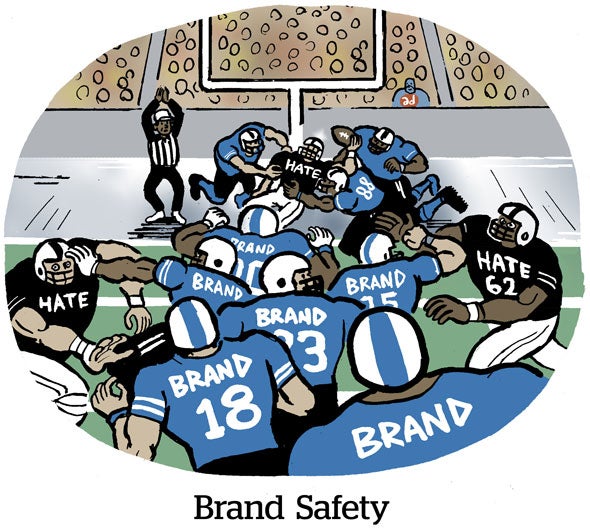
Even brand safety companies think news blocking has gone too far.
On Tuesday – and just in time for the US presidential election – DoubleVerify (DV) announced a so-called News Accelerator initiative to explore ways to help advertisers support legitimate news outlets and reach valuable audiences, while still keeping brands away from misinformation and disreputable sites.
Widespread blocking of news through automated brand safety tools has harmed both publishers and advertisers, acknowledged DV CEO Mark Zagorski. The industry needs a better way to bring news and advertisers together, he told AdExchanger.
As part of the initiative, DV has hired its first-ever head of news: Jack Marshall, a former senior reporter for The Wall Street Journal and Digiday, and co-founder of business media company Toolkits.

DV is also releasing a new set of brand-safe contextual targeting segments called NewsPlus and plans to launch a research-backed thought leadership project to prove the value of news audiences and dispel the myth that ads adjacent to news cause harm.
Better tools in the toolbox
The News Accelerator represents a striking reversal by DoubleVerify, which has ridden brand safety concerns about news and other content to become a publicly traded company with a market cap of nearly $3 billion.
But this isn’t a pivot out of nowhere for DV, said Zagorski, who previewed DV’s evolved thinking at an IAB event during the NewFronts in May by piling onto criticisms of automated news blocking.
Meanwhile, DV has been collaborating with news publishers and buyers for more than a year to devise a healthier programmatic buying methodology that addresses the concerns of both sides.
“We’ve always said that blocking news as a category is a bad advertising strategy, because it limits reach and impact,” Zagorski said. “[Publishers] are rightfully frustrated that a lot of the tools in the space were being misused, that advertisers weren’t refreshing keyword lists or using the controls DV has provided.”
For example, DV considers keyword blocking – where publisher pages get demonetized for containing words that could indicate violent news coverage, like “shooting” – to be “an ancient solution that is one part of a much broader control set that we have,” Zagorski said.
DV now considers it the company’s responsibility to promote more nuanced tools, like sentiment analysis, natural language processing and dynamic suitability controls, Zagorski said. It also claims to only block keywords contained in a page’s URL, instead of blocking any use of certain words within article copy.
Going forward, DV will conduct periodic reviews of advertiser keyword blocklists and alert clients when their lists are out of date, Zagorski said. It’ll also review the other brand safety parameters its clients have in place and call out instances where the settings harm campaign performance by severely limiting reach among news audiences.
DV’s research shows that news audiences have a 20% higher engagement rate than non-news audiences, so brands miss out on real opportunities when they cut out news, Zagorski added.
But, to be clear, DV will still offer advertisers access to keyword blocking, rather than removing that tool entirely. “Advertisers want options, where they can use an instrument that’s a bit blunter, particularly in breaking-news situations,” Zagorski said.
Brand-safe news targeting
Holding advertisers accountable for how they use DV’s tools is just one part of the News Accelerator. Another key piece is adding new tools that make advertisers feel confident to support the news without worrying they’ll be harmed by a bad ad placement.
That’s where the NewsPlus contextual targeting segments come in.
NewsPlus will offer a general brand-safe news targeting segment, including all news sites that clear DV’s Brand Safety Floor, which by default cuts out sites that contain extreme graphic violence, copyright infringement, malware and other obviously objectionable content, said Stephanie Posner, VP of policy, safety and global affairs.
The NewsPlus segment will also automatically exclude made-for-advertising sites and content that falls into DV’s inflammatory politics and news category, she said. And advertisers can fine-tune which content they’re comfortable monetizing using DV’s sentiment-based targeting tools.
Next, DV plans to roll out more granular contextual categories and already has “soft news” categories in the works for topics like sports and entertainment, Posner said.
Rather than creating private marketplaces of hand-picked news publishers, DV is applying its contextual segments across all programmatically sold inventory. This ensures the targeting segments aren’t limited in terms of scale, Zagorski said, and also avoids a situation in which DV is the one picking which publishers are brand safe.
“This is not a short-term, knee-jerk thing where people are pissed at DV about news, so let’s put something together,” Zagorski said. “This is an ongoing commitment to a healthy ecosystem that includes news and that will roll into 2025 and well beyond.”







