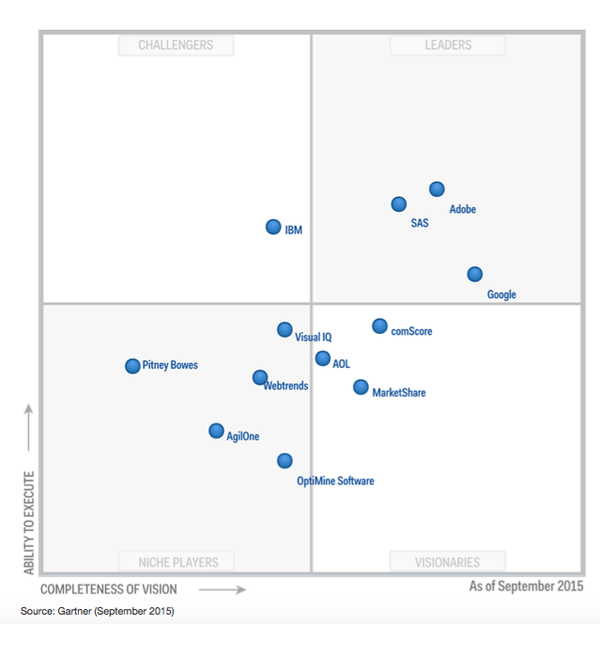
Marketers want integrated analytics solutions – a trend clearly demonstrated by the diversity of the players populating Gartner’s most recent “Magic Quadrant for Digital Marketing Analytics,” released Monday.
Adobe unsurprisingly took the lead, with SAS and Google trailing right behind. But in a sign of where the market is headed, attribution companies like Visual IQ also made an appearance on the chart, occupying the same niche status in the quadrant as predictive analytics provider AgilOne and web analytics vendor Webtrends.
It’s evidence that vendors within the hitherto separate worlds of traditional web analytics and media analytics are widening the scope of their solutions.
“The convergence is vivid in this space,” said Martin Kihn, research director at Gartner and co-author of the report.
That’s because the definition of digital marketing analytics is changing to make room for the volume, variety and complexity of the data that marketers must increasingly juggle on a daily basis.
Beyond simple reporting, marketers want solutions that solve for all of their needs in one place, from data integration, data visualization and marketing mix modeling to business intelligence, measurement and taking action on insights. Vendors are reacting to that need.

“Marketers desire tools to support more advanced marketing problems and handle more complicated data, and it’s putting a lot of pressure both on their own analytics teams to improve their skills and on the tools themselves to become easier to use so you don’t need a Ph.D. in data science,” Kihn said.
As devices proliferate and channels converge, “experience becomes the new battleground for competitive differentiation,” the report noted. That means tracking individuals on their journey from anonymous acquisition target all the way through to conversion.
“The marketers buying these products want everything within one tool and within the same data set,” Kihn said. “Marketers are driving this, and the larger, more ambitious vendors will follow.”
Kihn said he wouldn’t be surprised if there were several new players on the scene in time for Gartner’s next digital marketing analytics Magic Quadrant, especially among the business intelligence set.
Business intelligence products are a fixture in marketers’ toolkits, but many providers, such as Tableau Software and Qlik Sense, don’t include marketing-specific analytics in their offerings – things like out-of-the-box mix models, journey analytics or sentiment analysis. That represents a potential business opportunity for these vendors, Kihn said.
“Once they set their sights on the CMO and the CIO, they might shake up the whole landscape, and I’d expect them to get into this space fairly rapidly,” he said.
AOL is also a bit of a wild card. Although AOL made it onto the chart as a visionary due to its acquisition of attribution vendor Convertro in May 2014, it’s unclear what sort of impact its own acquisition by Verizon in May will have on its commitment to measurement. [The Verizon acquisition occurred in the midst of Gartner’s work on the Magic Quadrant.]
“Verizon doesn’t have a deep history in analytics or, indeed, in marketing measurement of any kind,” Kihn said. “As such, I would question how much they will support it and how much of a strategic priority digital marketing analytics will be for Verizon going forward. They say it’s a huge priority, but time will tell.”
Beyond digital marketing analytics, convergence in the analytics space dovetails with convergence elsewhere in the industry, namely between the marketing tech and ad tech sectors.
In Gartner’s inaugural Magic Quadrant for Digital Marketing Hubs, released in December, Kihn and his co-authors posited that ad tech, mar tech and CRM were each on their own road toward natural convergence, which is why the report evaluated enterprise players, including Salesforce.com and Marketo, alongside ad tech vendors, such as Turn, Rocket Fuel and MediaMath.
“It’s a forward-looking vision,” said Kihn, speaking of both digital hubs and digital marketing analytics providers. “It hasn’t happened extensively yet, but it’s clearly happening. By this time next year, there will be fully integrated solutions.”