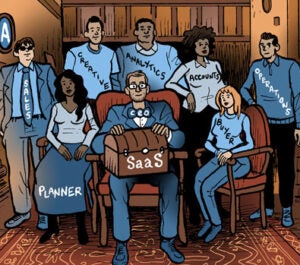
An emerging consensus among Wall Street investors, based on the earnings reports of companies like Meta and Alphabet, is that subscription software is on the way out.
AI may not replace Hollywood writers, electricians, nurses or many other professions. But it will replace SaaS software developers.
Or so the story goes.
LiveRamp, which reported its Q4 earnings on Thursday, is staring straight down the barrel of this conventional wisdom. Its shares have fallen by roughly one-third over the past year and, because it’s the main subscription hub for mar tech and SaaS companies – the SaaS vendor at the very heart of other SaaS business models – many investors see LiveRamp as a proxy for the entire category.

But LiveRamp is putting up a good fight.
Total revenue in Q4 was $212 million, up 9% year over year, with net profit at $40 million, up from $12 million the year prior. LiveRamp CEO Scott Howe boasted of “record operating margins.”
Still, the main theme of the call was the growth of AI and investors sharing their pessimistic positions on SaaS businesses.
“I’m bullish on the future,” Howe told investors during his opening remarks. “In contrast to what Wall Street may believe about the software sector overall, we believe AI is a tailwind, a true force multiplier for our platform as the advertising ecosystem looks to adopt AI in a trusted, secure way.”
What investors think
LiveRamp’s shares bounced back somewhat on Friday after the company’s earnings report and are up 2%-3% after a month-long descent.
Which is to say that investors are feeling somewhat reassured but still cautious.
The financials are sound, and LiveRamp is debt free, which are positives. Investors also credited Howe for engaging with their skepticism directly.
“I appreciate you addressing it head on, Scott,” said Timothy Nollen, a media and tech analyst for investment firm SSR LLC.
But Nollen also sounded a little anxious for the category.
“One of the concerns, I guess, is that AI will disrupt the software subscription business model,” he said. “And I just wonder if you could maybe give us some assurance that your customers are doing well. That everything is going well.”
For one, Howe responded, the AI platforms themselves are partners that increase data consumption through LiveRamp.
LiveRamp has used what Howe called “squishy math” to estimate how much of its activation business – meaning audiences that are shipped off to ad-buying platforms – already goes to AI use cases, like to a walled garden using an AI-based ad product or a third-party vendor like Chalice AI.
“We don’t always have visibility into what algorithmic logic is driving a decision at a partner,” Howe said, hence the squishiness. But LiveRamp’s best guess is that AI use cases already account for 10% of that business.
“I think it’s going to be an important stat to share with Wall Street,” he said. “We want to make sure our investors understand that this is a tailwind, not a headwind.”
Changing winds
But even if AI is a tailwind for LiveRamp’s SaaS business, as Howe claims, the company is still eagerly shifting away from the subscription business model where it can.
For instance, LiveRamp’s two most important new partnerships from Q4, Publicis and Uber Advertising, are based on usage – as in, based on data consumption or tokens – just like how cloud providers and LLMs charge their enterprise customers, rather than fixed fees per account or seat.
The contribution to LiveRamp’s revenue from these usage-based payments is small, essentially meaningless at the moment.
However, that’s because these arrangements start small and don’t include large upfront commitments, which are common for SaaS accounts, Howe said. One of the selling points for the usage-based system is that partners – like Uber and Publicis advertisers using those products – pay for what they use. And if they choose not to use the service, it doesn’t cost them much.
But LiveRamp’s usage-based contracts with Uber, Publicis and others will grow over time if those partnerships lead to more data being shared and used on the platform.
“Even if AI does disrupt elements of software,” Howe said, these AI platforms all need marketing data and clean room services to commingle different proprietary data sets.
“If all you’re doing is using models that are based on the world’s publicly available information,” he said, “then you’re going to be accessing the same models that everyone else is, and there will be no competitive advantage.”