 In the summer of 2008, Paris-based ad holding Publicis Groupe had started working on CEO Maurice Lévy’s pledge to derive at least 25 percent of the agency’s revenues from digital. The problem was that digital was still a sideline to the main business of creating and buying ads for TV, print and out-of-home. With those categories deeply set in their individual “siloed” disciplines, the company came up with the idea of forming a digital hub that would touch on the company’s various media buying and digital creative service functions. It called the unit VivaKi.
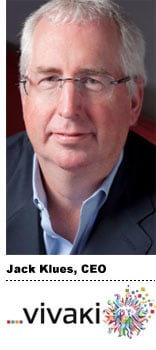
Now that digital dollars are generating over 35 percent of Publicis’ annual revenues, the company is ready to give VivaKi billing as a standalone company with its own P&L. As VivaKi moves on to its next phase, the man who helped form and run it as CEO, Jack Klues, announced he would be retiring at the end of the year. He will hand the reins to CFO Frank Voris.

“It makes sense to reinvent VivaKi now because the agency business has changed so much in the past four-and-a-half years since its inception,” Klues told AdExchanger in an interview. “At the beginning, it made sense that digital services would be a part of the larger media buying agencies in partnership with Digitas, which was acquired at the end of 2006. But now, what part of the agency doesn’t digital touch? The big change really is that VivaKi can serve all our agencies and, when the opportunity comes about, clients on its own.”
Klues hastened to add that his retirement was not a result of the changes at VivaKi. He will continue to work with the company through the early part of 2013 and says he will continue the relationship with VivaKi on an “as needed basis.” He added that he has no other ambitions of creating a startup of his own or going to work with a rival agency holding company. “I’ve been a corporate guy for over 35 years, so I have no desire to work in the startup world at this point in my life,” he said. “And I certainly would not work with a competitor. Neither did personal desires [to retire] lead to the change in VivaKi’s profile and positioning.”
Lévy approached Klues earlier this year asking him and the heads of the other companies in VivaKi’s orbit — Digitas, Starcom MediaVest Group, ZenithOptimedia and Razorfish — “to gear up for the next big thing, the digital evolution and a new set of client demands.”
Instead of coming through the media and digital properties within Publicis, those new client demands are coming directly through the more traditional creative and communications shops, such as Leo Burnett, MSL Ground, PHCG (Publicis Healthcare Communications Group), Publicis Worldwide, Rosetta and Saatchi & Saatchi.
In addition to accessing the VivaKi Nerve Center, which includes AOD (aka Audience On Demand, the media buying suite) and The Pool, its video ad solution, the VivaKi Exchange is likely to expand both within and beyond the dozen markets it operates in.
The formation of VivaKi was intended to meet the particular advertiser demand for digital to be at the center of their campaigns, whether it was primarily focused on traditional media categories or not. Over time, the demand has been to break down the siloes even further between traditional disciplines. At the same time, those demands have led some to question the viability of the agency model, though with so many billions of ad dollars still going through those traditional systems, extinction is unlikely. But shrinkage, especially in the face of social networks and “earned, unpaid” media, has compelled agencies to reevaluate the way they are structured.
“VivaKi, with its various functions, does not need executives like me looking over its shoulder constantly,” Klues said. “The process of working with it needs to be less managerial. These changes are meant to reflect a need for greater agency adaptability: we need to be a business that focuses purely on client service; agencies need to serve as a tool and as product support for the future agency model.”
That said, primary customers will continue to be the founding agencies. And SMG CEO Laura Desmond, Razorfish CEO Bob Lord, ZenithOptimedia CEO Steve King will still work with Voris and Rishad Tobaccowala, who remains VivaKi’s Chief Innovation and Strategy Officer, in managing VivaKi.