
Here’s today’s AdExchanger.com news round-up… Want it by email? Sign up here.
Buy, Build Or Borrow?
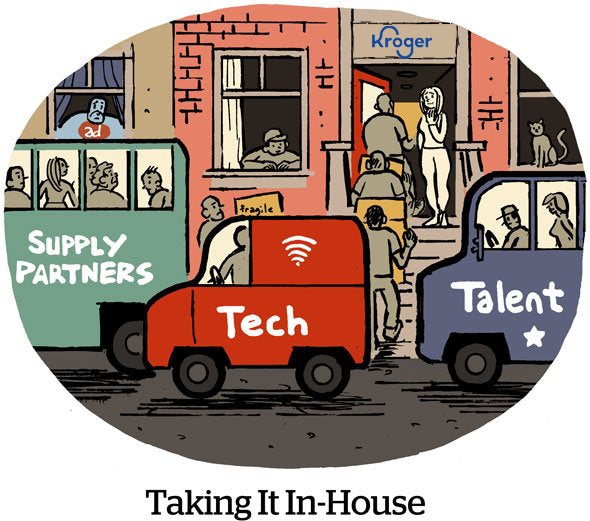
When should brands in-house their media and when should they turn to an agency?
Marketing consultant Alex Greifeld posts about this conundrum in her newsletter, No Best Practices. While practically every major brand needs advertising services in some way, bootstrapped or do-it-yourself efforts can yield major gains – although pushing the work onto an agency is tempting, according to Greifeld.
For instance, early-stage brands that spend only a few million dollars per year ought to do the work themselves, she suggests, because that’s part of the process of uncovering market fit.

“If you have a big pile of capital,” Greifeld writes, it can be easy and effective to let an experienced agency handle that out of the gate, but then marketers lose a chance to sharpen their own understanding of the product and perhaps make valuable changes.
Meanwhile, a brand that spends tens of millions and produces its own advertising assets in-house has a veritable “superpower” that will pay dividends over time.
But agencies still offer a strong value proposition for those that opt to work with them.
“What is dead or dying,” Greifeld writes, “is the premise that a brand will hand over a 10%-15% commission on monthly ad spend, no questions asked.”
The ABCs Of MFAs
A recent ANA report made waves by estimating that made-for-advertising (MFA) sites gobble up around 15% of open internet ad spend. But the conversation is still missing a consistent definition of exactly what MFA is. (The ad industry hasn’t even settled on a definition for “premium” yet, for Pete’s sake.)
But a consortium of trade orgs including the ANA, the 4A’s, the World Federation of Advertisers and the Incorporated Society of British Advertisers is working with Jounce Media and Deepsee.io to clarify the definition of MFA media.
According to the group, MFA sites are explicitly designed for buying and selling ads, rely on clickbait and provocative content to drive impressions and are laden with intrusive ad placements.
There are also five characteristics that most MFA sites have in common: a high ad-to-content ratio (on desktop, that means at least 30% of all media is ads); ad placements that auto-refresh at a fast rate; a high percentage of paid traffic with little to no organic traffic; syndicated or plainly scraped content; and cookie-cutter site designs.
Sounds craptastic.
For Reels
Facebook’s ad business rebounded over the past year and a half following a nasty downturn after Apple’s ATT release.
But Instagram is massively outpacing Facebook – to the point that WARC now forecasts Instagram ad revenue will surpass core Facebook ad revs sometime next year. And at a forecasted $71 billion in 2024, up from an expected $61 billion this year, Instagram is outgrowing practically everyone. (Even Amazon Advertising might envy $10 billion net-new ad dollars in a single year.)
In other words, Facebook isn’t falling flat; Instagram is just accelerating way faster.
Instagram’s biggest advantage comes from Reels, a short-form video product (i.e., a shameless rip-off of TikTok).
Instagram has been able to crank up Reels monetization by adding affiliate links, ad units, shopping integrations and more. But the growing enthusiasm for Reels is about more than ad revenue.
WARC says that Reels posts generate far more ad interactions and boost sales more effectively than other Meta formats. Most importantly, Reels campaigns can almost double the total reach of a typical Instagram feed.
But Wait, There’s More!
Big studios and streaming services announce the Streaming Innovation Alliance, the first streamer-specific lobbying org. [Axios]
Newsletter publishing startup Beehiiv acqui-hires newsletter ad network Swapstack. [The Information]
The FTC sues Amazon for alleged monopolistic marketplace services that degrade quality for shoppers and overcharge sellers. [Bloomberg]
TikTok’s ecommerce ambitions face new regulatory obstacles in Indonesia, its biggest ecommerce market. [Time]
The Media Rating Council issues accreditation for iSpot’s ad occurrence catalog (although not audience measurement – yet). [Ad Age]
ChatGPT gets chattier (and sounds nearly human). [WSJ]
YouTube is axing its ad-free Premium Lite subscription plan. [The Verge]
Comscore’s Proximic rolls out new contextual targeting features. [NextTV]
You’re Hired!
David Krulewich is Audiohook’s new CRO. [post]
GumGum hires Kenzo Selby as managing director for Japan. [release]
Paramount names Lydia Daly as SVP of market and audience intelligence and Karim Mawji as SVP of global client partnerships. [NextTV]
Ocean Media appoints Matthew Aronowitz as its VP of data science and marketing technology. [release]







