
Here’s today’s AdExchanger.com news round-up… Want it by email? Sign up here.
Thanks For Not Sharing
Non-advertising companies can end up with strange new incentive structures when they start collecting ad dollars.
For instance, the more Netflix’s ad revenue grows, the greater the internal pressure to crack down on password sharing.
Previously, Netflix could turn a blind eye to password sharers, because scaling distribution and getting people’s attention were two of its top priorities. But with the launch of its cheaper ad-supported tier, Netflix can force password sharers to pay their own way.
Most won’t leave entirely, or so the thinking goes. Instead, they sign up for ads.
But there’s another reason why Netflix is turning the screws on password sharing: Those viewers throw off the identity set and, thus, campaign effectiveness. Friends, family and sometimes even strangers are “masquerading” behind one account holder, writes Eli Heath, Lotame’s head of identity, in a column for The Drum.

What ends up happening, he says, is that the watch history of all users under one account is blended, which leads to poor targeting, attribution and prospecting across the board. The data stops being useful as a deterministic seed set, which is necessary for accurate probabilistic modeling – and for scaling campaigns across the web.
Game Over (Start Again?)
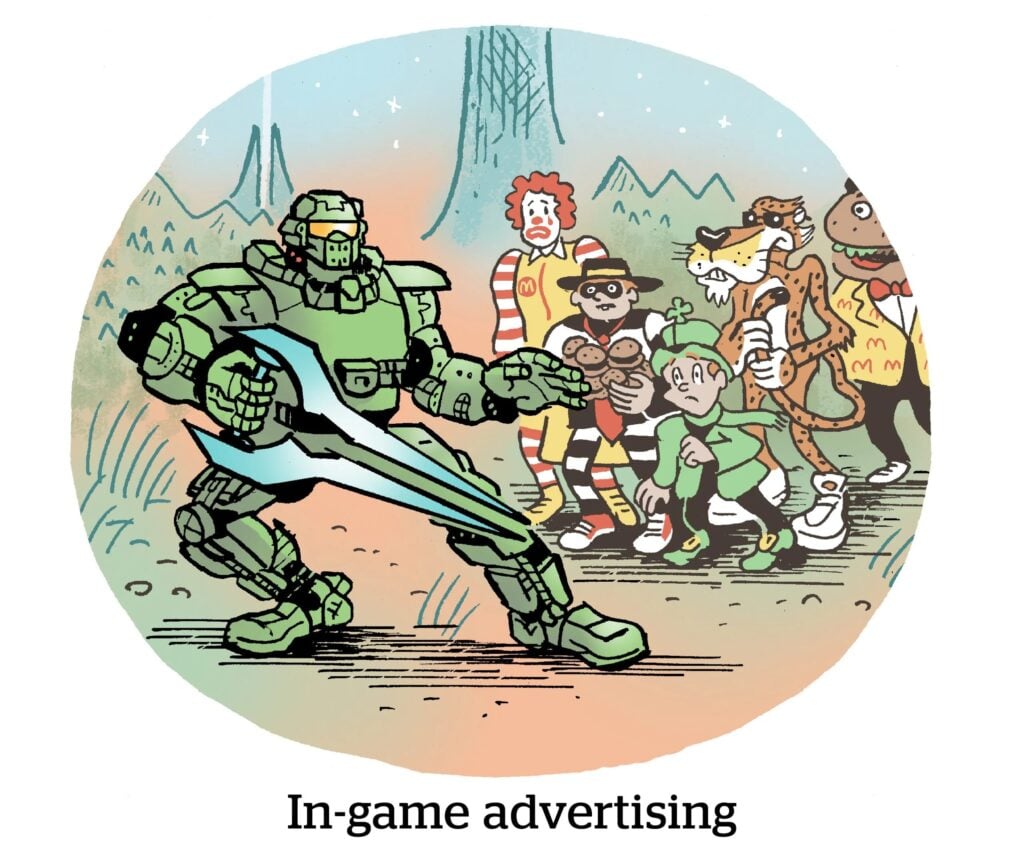
Microsoft expects mobile in-game purchases and advertising to be its primary gaming revenue drivers over the next few years, CNBC reports. The data comes from a leaked internal presentation that was mistakenly made public during court proceedings for Microsoft’s Activision Blizzard acquisition.
Microsoft forecast its ad revenue will surge to $1.4 billion in 2030, up from a mere $100 million in 2022. In-app transaction revenue, which only got going last year, is benchmarked to reach $2.6 billion by 2030.
Together, Microsoft’s in-game advertising and mobile commerce revenue are projected to add up to $4 billion, or 11% of the company’s total gaming revenues.
These projections underscore why Microsoft is gunning so hard to close this mega-deal. Its gaming revenues are tied to console and PC games, but Activision Blizzard – which owns King, publisher of Candy Crush – is Microsoft’s bridge to the mobile market.
Left Is The New Right
Biden’s two Republican Federal Trade Commission nominees, Melissa Holyoak and Andrew Ferguson, appeared before the Senate Commerce Committee during a nomination hearing on Wednesday.
Usually, the FTC has five commissioners, and the president traditionally splits the nominees 3-2 in their own party’s favor. But the current FTC had three members – and all Democrats – since late March, when the conservative commissioners quit earlier this year in a huff over what they felt was an overly aggressive approach to reining in Big Tech companies by Chair Lina Khan.
The current FTC needs a bipartisan balance.
But we live in a weird world.
Both conservative and left-leaning groups have lobbied senators to vote against the two nominees, the Washington Examiner reports. Why? Because they both have ties to Big Tech. Republicans are torn internally as to whether the new commissioners should be anti-Big Tech or not, and Democrats want nominees with a strong record of going after Big Tech.
Holyoak is solicitor general in the Utah state attorney general’s office and led other states in petitioning support for Epic in the Epic vs. Apple antitrust suit. Ferguson is solicitor general of Virginia, a state participant in the Google antitrust lawsuit.
But Wait, There’s More!
How the TikTok Shop pitch has gone down with marketers. [Digiday]
Google has been working on a generative AI “conversational experience” that would talk to advertisers. [MediaPost]
The cable and streaming singularity comes closer as Max plans to offer free live sports streaming until March 2024. [Fortune]
Conservative social media site Rumble had exclusive streaming rights to the Republican primary debate – but it was boxed out of Google Search. [The Intercept]
You’re Hired!
BET Media Group names Tiyale Hayes as EVP of insights and multiplatform analytics. [release]
Generative AI startup Phrasee announces Dan Head as its new CEO. [release]







