
 Hang on to your hats – the world is going to end!
Wait, why bother hanging on to your hats if the world’s going to end?
Another report came out showing a slump in ad spending year over year. This time its Pubmatic’s quarterly review of display advertising pricing, the AdPrice Index, as seen from the teet of Pubmatic’s ad revenue optimization product.
Over at TechCrunch, which never met an embargo it ever liked, Erick Schonfeld has proclaimed that Pubmatic’s data confirms that the Four Horsemen may have arrived: the ad slump is baaaad, very baad. OK, Erick, take a breath.
According to the report, 5,500 publishers currently use Pubmatic’s yield optimization services which revealed “a significant decline in Q4 2008 online display ad pricing compared to Q4 2007 for all sizes of websites and all vertical categories.” “Small, medium, and large sites dropped 52%, 23%, and 54%,” respectively, in average CPMs from Q4 2007 to Q4 2008.
Well, that does sound bad. But given recent developments in the economy, could we have expected something different?
Let’s look at the CPM graph by vertical from the Pubmatic AdPrice Index report.
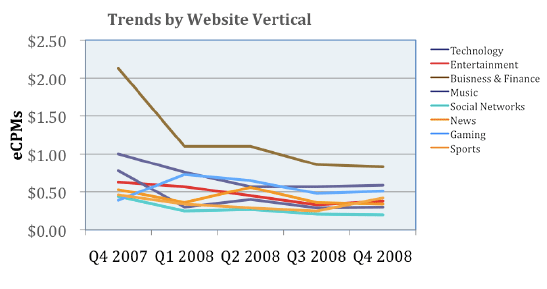
That big, sloping, brown line is Finance CPM’s. Ouch. Are there any advertisers from the financial industry anymore?
Now, let’s look at another graph. This is a graph from Compete of the growth for the three largest publisher yield optimizers – Pubmatic, Rubicon Project and AdMeld from Q4 2007 to Q4 2008:

With this graph in mind, have a look at the year over year Comscore numbers from the ad exchanges and networks. Everyone is getting bigger.
In spite of all the bad ad spend news, ad exchanges, networks and yield optimization companies are continuing to grow in reach and uniques. Yet, the CPMs are going down in the remnant display that Pubmatic tracks at the very least.
How can this be? We offer a few inter-related ideas on how CPMs are falling, and exchanges and networks are growing:
Less Ad Dollars – It cannot be denied. There are just fewer ad dollars out there. Layoffs at agencies, such as Ogilvy letting 10% of its North American staff, are well-documented. The advertising industry isn’t what it was last year. The good thing for large agencies is that it gives them an opportunity to streamline their operations toward a digital future, if they’re smart. Less ad dollars means less competition for placements with other advertisers and drives CPMs down.
More U.S audience – According to Comscore, the total U.S. Internet audience is up to 4% to over 190 million uniques. More people creates more page views and impressions.
More inventory – More websites are created every day – large and small. And with pressure on sites to effectively compete for ad dollars while driving revenue, more content is being created all the time.
Daisy chaining – When a publisher daisy chains ad networks and exchanges, potentially 2 0r 3 will see the same unique user and impression. This effect helps inflate any ad network or exchange scale metric as a publisher tries to maximize their yield and throws latency to the wind.
Yield Optimizers – These are the publishers’ trading partners on the exchange, if you will: Pubmatic, Rubicon Project and AdMeld. They generate more revenue for publishers – on the other hand (and now we’ll go against conventional wisdom) the extreme technology creates more competition on the publisher side. Yield optimizers tap into more networks and exchanges than any one publisher ever could. Consequently there is more competition at the “trading desk” of each exchange or network as optimizers make deals and try to get the best price possible for its legion of publishers (Look at those Compete numbers. Optimizers are here to stay). Logically, CPMs will go down. But, the great shakeout that leads to the inevitable expansion of the efficient, transparent exchange model continues. Advertisers will compete, too, eventually and cause CPMs to rise. But during an ad slump, advertisers hold the cards on pricing.
Finally, advertisers need reach and frequency whether for a brand or direct response campaign. Individual publishers cannot deliver it efficiently. Enter the ad exchanges and the ad networks which grew strongly at the top end in 2008.
More: Pubmatic Blog









