
Here’s today’s AdExchanger.com news round-up… Want it by email? Sign up here.
Blown AMP
Publishers are pulling the plug on Google AMP.
Vox and BuzzFeed (and other titles within their portfolios) are testing or considering testing their own mobile optimization pages, which they expect to generate at least 20% more revenue than Google AMP pages without a noticeable increase to site latency, The Wall Street Journal reports.
The publishers say ditching Google AMP will also give them more control over page layouts and ad placements. With proprietary mobile optimization solutions, publishers have flexibility to auction impressions on a range of ad exchanges. This is an example of header bidding bringing more competition, thereby increasing potential ad revenue.
And – bonus! – publishers will rely less on Google.
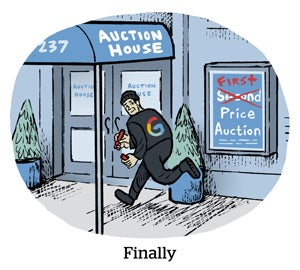
The move away from Google AMP follows disclosures in a Texas state antitrust case backed by multiple attorneys general that revealed instances where Google tampered with programmatic auctions and seemed to prioritize Google AMP links (and throttle non-AMP traffic) in search results.

Newsed And Abused
CNN and Applebee’s took a ribbing online yesterday after an ill-timed live, in-feed commercial surfaced on screen just as sirens began blaring in Kyiv, Ukraine following the Russian invasion. Ad Age wrote up the cringey juxtaposition of the ad and the online blowback.
It’s easy to make jokes at the expense of Applebee’s or to point out that some added nuance is expected if CNN tries new ad formats that run alongside breaking news … while, you know, a war is breaking out. On the other hand, it’s another example of how important news is crippled and disincentivized by the judgment of social media mobs and hampered by brand safety practices.
Most brands are naturally risk-averse. There’s so much media out there, so why attach your name to a news story if it may make you the joke of the day online? For that matter, why not block all news involving Russia? It’s a slippery slope. But legit war coverage aside, you could end up alongside an article that turns out to be Russian propaganda. So, better safe than sorry.
But CNN is placing journalists in Kyiv at massive expense. If anything, there should be competition among brands committing to back on-the-ground or in-depth coverage. Unfortunately, though, what often ends up happening is advertisers shy away from the risk – and valuable journalism becomes ever-more unsustainable.
Applebee’s later followed up with Forbes editor Marty Swant to confirm that the brand had paused advertising on the network.
New Address
Remember PRAM? That’s the Partnership for Responsible Addressable Media, for those who’ve had it up to here with acronyms. Well, soon it’ll be no more.
PRAM will wind down its operations and transition governance over addressable media IDs (AMIs) to the Digital Advertising Alliance (DAA). Yep, that’s our industry, folks, one in which the sentence “The DAA is taking over AMIs from PRAM” actually makes sense to someone.
PRAM was launched in August 2020 as an initiative of some 400 advertisers, agencies, publishers, ad tech companies and other trade orgs in the quest to create digital ad standards that satisfied web privacy, user experience and monetization. (Call it alchemy, the Holy Grail or Personalization with Privacy.)
A year ago, PRAM solicited input on potential new technologies to replace cookies and other identifiers. Having evaluated multiple AMIs, including The Trade Desk’s Unified ID 2.0, PRAM concluded its work with the release of a policy framework that lays out the do’s and don’ts for creating AMIs. As in, do provide consumer choice and don’t forget to get permission.
The DAA is now in charge of refining the framework and managing the application and review process for AMI certification.
Hope springs eternal on the long road to a cookieless future.
Cloudy With A Chance Of Meetups
Cloud data software companies are extremely competitive, but they need middleware services that integrate neatly across many providers. Which is partly why dbt Labs, a tool for integrating and working across common business applications and cloud tech providers, just raised $222 million (at a $4.2 billion valuation) from Databricks, Snowflake, GV (Google’s VC unit) and Salesforce Ventures.
An interesting factor buoying dbt Labs is that it’s a community-based brand, as founder and CEO Tristan Handy stresses in a post announcing the news. It’s got a newsletter, hosts meetups, has some 25,000 members on Slack and a largeish conference – so you’d be forgiven for thinking dbt is some new media startup.
What’s the takeaway? Tech can be reproduced. But if you have a meaningful community of data and analytics professionals, the biggies want to be part of your road map (and make sure no one company individually has too much influence).
From the perspective of companies like Amazon, Google, Salesforce, et al., having an engaged community of backers may be the most important differentiator as an independent player.
But Wait, There’s More!
Why Apple’s App Store fight in the Netherlands matters. [NYT]
Making it rain: Mobile monetization provider AddApptr announced a $60 million investment from the Aonic Group [release]. An “experience relationship management” platform raises $47 million [VentureBeat]. Latina-owned Canela Media secures $32 million [Forbes]. The “ethical ad tech” startup Good-Loop snags $6 million PE backing [TechCrunch].
BuzzFeed pens an exclusive deal with Stellar Partners to set up airport store locations. [release]
Brian Morrissey: The end of an era for ad targeting. [Rebooting]
Not just groceries: Instacart adds Lowe’s as its first home improvement retailer. [release]
You’re Hired!
Tom Schutz is named CRO of Ascential Digital Commerce. [release]
MiQ names Sean Reardon as global CEO, and Co-Founder Gurman Hundal assumes the role of global executive chairman. [release]








