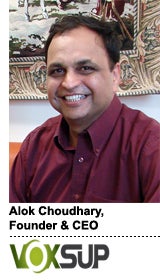
 Facebook Preferred Marketing Developer and newly inducted Twitter Ads API partner Voxsup is applying data science to social media to help brands smartly segment audiences.
The company is VivaKi’s preferred partner for social insights and Facebook ad-buys, working alongside partner The Echo System. Drawing on algorithms developed at Northwestern University by CEO Alok Choudhary, the software-as-a-service application provides clients including the PGA Tour and Discover with interest-based segment targeting capabilities and analytical insights.
Voxsup has yet to take external financing. Choudhary claims the platform is among Facebook’s top ten, if not top five, in terms of ad spend. He spoke with AdExchanger recently.
AdExchanger: What problem does Voxsup solve?
ALOK CHOUDHARY: As more and more people spend time on mobile devices and social media, as well as engage with communities, brands and shows, everyone wants to reach out to those people through these channels. One of the problems is, marketers have so many channels now — especially the social channel, which is very relationship-oriented rather than just transactional.

Can you give an example of how a company would use Voxsup to improve its understanding of its audience?
There are multiple aspects to this. Using our data science and analytics, we provide the client segmenting and targeting information, which is what we call “non-obvious” information because everybody can understand the obvious.
For example, a financial company would be interested in people who are more engaged with CNBC or the Wall Street Journal on social media. However, our main premise is that the goal is to reach people with behaviors [they don’t necessarily exhibit] through that particular channel. For example, a person engaged with the Wall Street Journal may also be engaged with the Chicago Blackhawks or the Museum of Modern Art. We look at segments through “windows,” rather than back-optimizing spend where the site retargets the messaging that one can do. For example, with the PGA – by using social media effectively we were able to increase ticket sales year over year by more than 60% using much less money. We are bringing both geographical [data] as well as segment information that had never been looked at before. Similarly, for a retailer, we are able to segment shoppers and reach out to people who are engaged with retailers or their networks or communities and go through their “windows” and find those people based on social media analytics.
You’re new to Twitter’s Ads API partner program. What’s possible there that you couldn’t do before?
There are things clients can do now that they hadn’t been able to do before in terms of productivity and performance. It was very tedious and unproductive to have to do things one-by-one. Our platform allows clients to create hundreds of thousands of small ads and campaigns that are tightly targeted with a few clicks, and the productivity goes up an order of magnitude in real-time…without the APIs, this would not be possible.
AdExchanger Daily
Get our editors’ roundup delivered to your inbox every weekday.
Daily Roundup

Regarding Twitter’s angle on TV, what with its snap-up of Bluefin, are agencies and brands talking about Twitter for TV?
We are very excited about the potential of connecting brands, networks, and TV programs – particularly using social media…but a lot more needs to be done. We have [begun to create] a framework to tie social behavior analysis on Twitter to offline behavior. It’s important to understand that people are watching all over the world on various devices. It’s a global rather than a local thing and Twitter and social media in general allow you to understand these connections and segments with the ability to understand languages natively. We are working on a pilot and initial product using social networks to allow clients to optimize TV and second screen to go beyond keyword engagement and really use the velocity of social networks and geolocation.
We hear so much about a “closing of ranks” between CMOs and CIOs, especially from a budget and priorities perspective. What are your thoughts on big data science as it’s applied by marketers? Is this still nascent or under-utilized?
I would say it’s nascent and there are still many things that have to come together, whether it’s agencies or clients, because marketing/analytics have the capability of producing what I call a silo bust. Traditionally, you had functional units and silos in an organization, and once you start to use big data and analytics, those have to come together.
What are your near-term goals, from a people and product development perspective?
We are seeing significant growth. We have a presence in Asia, Europe, and of course, the U.S., already. Our company is it is very science-focused, so a lot of my former PHD students are part of the company, and part of the development and design… [in terms of employees] it’s less than 100 and more than 20 at this point but we expect significant growth over the next two years, having seen order-of-magnitude growth just over the past year.
Our goals will be to enable businesses to leverage big data science technologies in our platform and do effective communications promotion, marketing, and customer attribution. There’s no reason that a small or medium business is not able to use social media to achieve their goals if the technology can very simply guide them and enable those things…that’s our big picture goal. In the near future – using social media, whether its Facebook or Twitter – it’s, “How do we bring in this technology where our platform can be used by hundreds or thousands of agencies and small businesses to improve their marketing and communications?”