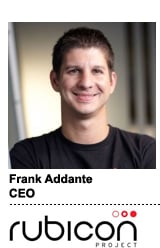
 Rubicon Project went public earlier this month, becoming the fifth ad tech company – give or take – to do so since the IPO door was flung open around this time last year. Since then its stock has had a bumpy ride, but no more so than some others in its class.
CEO Frank Addante would argue that no other public ad tech company is in Rubicon’s class. For one, the company has positioned squarely as a pure enterprise software seller. In other words, repeating revenue from software fees and no big media margins – unlike ad network businesses Rocket Fuel and Criteo.
Rubicon now has 700 sell-side customers, on behalf of which it has trafficked campaigns for 100,000 advertisers globally. But it’s no longer focused strictly on the publisher opportunity.
“We’ve never called ourselves an SSP,” Addante said. “That’s where we started, but it would be like calling Apple an iPod company today.”
Addante spoke with AdExchanger.

AdExchanger: One thing that jumped out from your S-1 was your repeated use of the phrase “advertising automation cloud.” Why that positioning and not “programmatic?”
FRANK ADDANTE: I don’t like the word programmatic. I think it implies a bunch of robots doing things without human input. Automation is much bigger than algorithms.
If you look at travel as an example, you can buy something as a bid using Priceline, you can buy it in a private marketplace using Expedia, or you can buy directly by using Delta.com or through an American Airlines agent. We do the same thing for advertising, whether that’s auctions or orders. Programmatic is a piece of it, but not the only piece of it.
(As for “cloud”), part of our DNA from the very beginning was being that pure play software company.
Some are under the impression that you have a markup buried in your demand-side fees. Can you talk about your revenue from ad networks, agencies and other ad buyers?
Our model is fixed-fee; it’s transparent. The fee is agreed to in advance. If you look in the S-1, you’ll see that our “take rate” last year was 17.3%. That take rate is in line with a software processing platform.
That’s unlike others you might find in the industry that are taking 40-50% margin. Which is fine, but that’s a very different kind of business.
Do you see your take rate being consistent at 17% or so for the foreseeable future?
Unfortunately I’m not able to make forward-looking statements.
You see, an IPO is not just a financial event. It changes the way you communicate.
One of our cultural values is transparency, so that’s hard for me.
What will you do with the money raised in the offering?
Invest it. We haven’t raised any capital for the past three years. We’ve been operating off of our own cash. We’ve raised $52 million in capital to date prior to the IPO, much less than a lot of companies in the space.
We ended last year with $30 million in cash, and that’s with all the investments we’ve made over three years – geographic expansion, product expansion, a couple acquisitions. For us, this is the capital to grow.
Our vision has been to automate all advertising, but our market entry strategy was to start with digital. We have a leadership position in display. We’ve entered mobile. Video is on the horizon. But obviously, it’s our plan is to automate all advertising including television and digital billboards.
How do you get there?
A large portion of our investment to date has been in technology and research and development. It’s the inverse of what you’ll find with a lot of other advertising technology companies, a lot of which invest pretty heavily in sales and marketing. We’re continuing those efforts in R&D, expanding our engineering staff. When we enter markets, we typically don’t copy and paste what’s been done. Typically we rethink the real problem in the market and try to innovate ideal solutions for it.
How do you view “programmatic direct” opportunities?
We break the whole marketplace down into three parts. One would be static bidding, the second real-time bidding, three would be “orders.”
One thing that’s important to the orders market is that it requires transparency. It’s a whole different category that doesn’t require static bidding or real-time bidding. When you talk about direct, reserve and a whole bunch of other jargon that I don’t like to use, that’s very different from a direct deal. It doesn’t require bidding at all. It just needs to be executed by the platform.
Our goal is to enable the market and grow the market. That’s part of our placement – to tie people together.