 “How do we deliver analytics in a way that is inexpensive – and not a headache?”
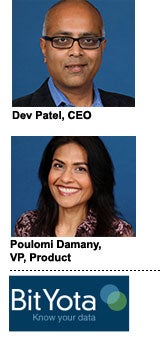
That is the high-level proposition behind BitYota according to Dev Patel who co-founded the company with fellow, former Yahoos Harmeek Bedi, Soren Riise and Poulomi Damany. And last week, he and his company took the wraps off of their solution (see release) as well as a $12 million funding round courtesy of venture capital firms Globespan Capital and Andreesen-Horowitz, among others.
With mountains of data to interpret, Patel believes that – as it relates to the analytics world for ads – “If the right tools and technologies were available, the agencies would love it.”
The seeds for BitYota came from Patel’s six years of experience with ad products at Yahoo where he saw analytics solutions that were either high-cost technology or do-it-yourself, open-source technology. Since open-source has its own evaluation challenges, according to Patel, the best option is “to create a business that provides software‑as‑a‑service for data warehousing to a large number of companies for whom data analytics suddenly becomes possible. Over the last 12-14 months, we’ve created technology that allows us to offer a warehouse as a service for ‘big data’ analytics.”
For now, the BitYota offerings are designed using infrastructure on Amazon, but Patel promises his company will deploy on other infrastrutures in the future. And that might be a good thing since – as The Wall Street Journal reported last week – Amazon has decided to get into the data warehousing business, too.
AdExchanger spoke to Patel and VP of Product, Poulomi Damany, about BitYota’s application to advertising.

DEV PATEL: Let me use an example of a customer that we have in the ad tech space. This customer wanted to understand the likelihood somebody is going to buy at a specific price – in other words, build a probability matrix of somebody wanting to buy a product.
They had used an in‑house solution that may have taken nine hours to implement. Because it took them nine hours, they might have used it once a month. Using our system, they are now able to run this algorithm to understand the likelihood of a purchase every five minutes. As a result, they can generate much more revenue because the likelihood of conversions is based on most recent data rather than something that you do once a month or a little bit beyond that.
When you look at problems big companies like Yahoo have solved, the opportunity is still wide open for a lot of other companies in the advertising system to use technology such as this and benefit from it.
POULOMI DAMANY: Ad tech companies are the most aggressive in terms of generating large amounts of data, using multiple data sources, and needing to analyze it very quickly. An ad has to appear in 600 milliseconds — and that ad better be relevant for you to make any money on it. Ad tech companies need the ability for their analysts, not programmers, to quickly analyze campaigns on the fly and make changes as the campaign is running.

Consequently, it’s important to note that BitYota supports SQL, a widely‑used analytics language.
What can you say about the tension between the analyst and the developer today and their respective responsibilities?
DEV PATEL: First off, Big Data has suddenly put demands on systems, and the systems haven’t been up to it. That means the analyst is hungry for more data from different parts of the data ecosystem and is dependent on many other people downstream that can make data available.
Those “other people” could be a developer or an IT function which cannot handle it straight away. It may take three or four weeks to make the data available, in fact.
Another thing that has happened is people have moved to open source technologies, which are better at coping with Big Data. But, the analyst finds himself or herself dependent on developers to make access to data, or processes, with open source.
There’s a bit of a dependency growing amidst the use of the new, open source tools, which are developer friendly, but not necessarily analyst friendly.
We’re solving the Big Data through software-as-a-service but, more pointedly, through tools and an ecosystem that’s well‑established.
POULOMI DAMANY: Just to add to the reasons for tension between analysts and developers, a lot of it comes from the fact that the development resources are stretched. If you have eight engineers who are working on a product, you may not be able to spare one to work on data processing.
What about data visualization? Is there anything that you’re doing in particular that would address the visualization of data?
POULOMI DAMANY: Dev and I talk about this all the time. How do we take that last step to data visualization? Right now, we’re focused on making this data accessible through an IT team and a dashboard, through any standard virtualization tools that one chooses. We’ll look for either doing an open source bundle [for data visualization] or potentially partner with somebody to visualize Big Data in an interesting way.
So, why couldn’t Oracle, IBM or another company like that do what you’re doing?
DEV PATEL: There are several reasons beyond just the business-driven reasons.
To build such a technology, which can handle data from different structures and formats as well as handle the velocity and volume at which data is coming, you’ve got to think about building something from the ground up. You’ve got to think about how to leverage the next generation of architecture, too, so we’ve designed it from a use case that is cloud-driven. Some of the technologies that you mentioned were not necessarily designed with an approach that was cloud-driven because that kind of an approach didn’t exist several years ago.
How does pricing work?
POULOMI DAMANY: The pricing is based on use. We have tiered plans based on the amount of data and the kind of usage such as performance-driven, volume-driven and so on.
DEV PATEL: It depends on what you use. You don’t need to scope your system based on what will happen in three or four months. You grow your usage elastically as the demand for your data grows.
You’ve identified some silos beyond advertising in your go‑to‑market strategy. What are those?
DEV PATEL: That’s right. Big Data is all over the place. Vertical markets which are really going to be on the front lines of Big Data, and where they need have a business advantage is how we boil it down. The markets where we’ve seen initial traction are app technologies, web technologies, social technologies.
Where are you in terms of head count today? And now that you’ve received this latest round of funding, how do you build out the team? Is it time to go hire a bunch of sales and marketing folks?
Today, we are 15. In Q1 2013, more business and tech folks will join the company.
In terms of milestones that you’d like to accomplish in the next 12‑18 months, what are some of the key ones?
DEV PATEL: In 18 months I’d like to hear somebody say, “BitYota did to data warehousing what Salesforce did to CRM,” Obviously, the consequent milestone to getting there is the ease of use – and cheaper for somebody who wants to do analytics – and no long procurement cycles that require a company to hire six Java developers. We want to take all those headaches away, and then that’s how we’ll succeed.
Follow AdExchanger (@AdExchanger) on Twitter.