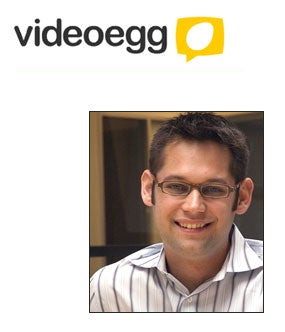
Matt Sanchez is CEO of VideoEgg, a rich media advertising network.
 AdExchanger.com: Can you give us a sense of current momentum at VideoEgg? Any effects from the economy? Have clients changed their buying strategies?
MS: We are delighted about the traction we are getting. 2008 revenue was up 110%. This year we are up more than a 100%. While we are seeing softness in some sectors, advertisers are clearly enthusiastic about Cost-Per-Engagement (CPE), the performance pricing approach we pioneered, and the richness of the advertising experiences that VideoEgg offers. We’re also continuing to enhance our targeting capabilities and this too, is driving our business growth.
Are advertisers using social media profiles or social graph effectively to target consumers with ads on the web today? If not, how far away are we?
At the most basic level, social media is providing the industry with a source of demographic and interest data that did not previously exist. This data is being utilized widely by publishers and networks. A number of companies are experimenting with relationship data as a basis for targeting, but it is too early to tell how this will affect brand advertising. On the other hand, there are other companies using social data to customize the ad experience. So far, though, this approach has received pretty negative reactions from consumers.

Social technologies like RSS, Twitter, Facebook Connect, Digg etc. are excellent tools to integrate into the ad experience and drive “earned” media performance. We integrate all of these and more into our AdFrames rich media technology.
Would you say VideoEgg is an ad network for rich media including video? How does VideoEgg differentiate itself?
I would say we are a performance-driven audience network for brands. We utilize innovative rich media technology to deliver interesting and functional ad experiences. Our network is constantly evolving. We are interested in any digital environment, as long as we can cost effectively deliver the attention and audience that our advertisers value.
We differentiate ourselves on a couple of levels, but first and foremost, we are network- and approach-optimized for attention, not clicks. We sell attention. The VideoEggNetwork is optimized to quality digital environments that deliver attention. Attention is the basis of our Cost-Per-Engagement (CPE) pricing model, and extends through AttentionRank, which is what we’ve coined as the way to optimize ad placements to maximize time spent with an advertiser’s content. Our AdFrames rich media platform delivers the most engaging advertising experiences across any digital platform.
We’re also poised to make several key announcements in the near future that will further exemplify why we’re so different than other ad networks in the space right now. You’ll see new solutions focused on how we uniquely leverage data as well as how we creatively capture and sustain user interest.
Additionally, we are committed to understanding the business impact of online advertising and are investing a significant amount of energy and money in our research and data competencies to make this happen. Our ability to demonstrate ad effectiveness through a variety of research services positions us as strategic partners with agencies and clients.
Your new AttentionRank approach for advertising seems like a new CPA, if you will – “cost per attention.” I see you call it “cost per engagement” or CPE. What challenge are you trying to solve with AttentionRank?
AttentionRank is an optimization approach that we utilize to deliver impressions to sites and environments, or even a particular place on a web page, where people are more likely to spend time with a message. CPE is our pricing model. We charge advertisers only when a user engages with an ad. We never change for impressions.
What are the key drivers in getting brand marketers to step into online media?
Brand marketers need a scalable way to access audience. As importantly, they need to do it in a way that enables them to tell stories and influence perceptions. TV was perfect for this: it was scalable, easy to buy and a very good story telling medium. Plus, consumers knew what to expect with TV. While things have changed today, we are making the internet work for brands by giving them a better way to inform and entertain across hundreds of sites and millions of people. We will continue to find new ways to do this as the medium evolves.
What effect do you see the exchange model having on digital media buying?
For the foreseeable future, exchanges will be important for part of the marketplace where buyers and sellers can abstract out much of the complexity. It will take several years before exchanges support the kind of rich experiences we deliver.
How do you see agencies needing to evolve as technology continues to automate digital media buying?
Agencies need to continue to focus on solving marketing problems and helping brands create compelling content platforms. Digital media is creating more complexity, not less, so brands will continue to look for partners to help them manage the marketing challenge. We are living through an evolution in the agency landscape where service offerings needs to change to meet the needs of digital. Agencies will develop competencies with data and technology, reposition PR as part of the mix, learn to move faster and evolve compensations models. But the need for agencies will not change.
How does VideoEgg ensure that it does not cannibalize publisher partner inventory?
We aggregate inventory across a lot of sites, overlay data and sell audience. We are transparent about our network but do not sell specific sites. If a buyer wants to buy a specific site, we do not get in the way. Our new VideoEgg ToGo solution allows buyers to take the VideoEgg ad experience to any site that’s a part of their larger buy for free, eliminating incremental rich media costs. We also work hand-in-hand with advertisers to get the creative up and running on other sites.
From your vantage point, any recommendations for online publishers who are steadily seeing CPMs decrease?
We think performance creates value. Publishers that can deliver the right audience and get them to spend time with a brand’s message will be able to manage CPMs. Finding innovative ways to blend ad messages and content is paramount.
Follow Videoegg (@videoegg) and AdExchanger.com (@adexchanger) on Twitter.