

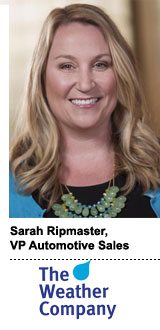
 As part of The Weather Company’s shift to a vertical-based sales organization, it has hired Sarah Ripmaster as VP of automotive sales.
Ripmaster, who has a decade of experience working with auto manufacturers, will help advertisers use The Weather Company’s location data, weather data and the Watson Ad platform in their ad campaigns.
Ripmaster worked at data management platforms Neustar and Aggregate Knowledge and most recently consulted for Annalect. She had heard over the years that The Weather Company ranked as one of the top-performing partners on auto companies’ media plans, on par with endemic sites.
She joined because of its reputation but also because the IBM-owned company’s assets go well beyond its app and website.
“Weather is a tech play and a data play, just as much as it is an owned-and-operated media play,” Ripmaster said. “Not just auto, but really any industry needs to have a strategy based on weather and location.”
For auto advertisers, using Weather’s combination of data, location and media plays out in a variety of ways.
Via the Watson ad platform, which debuted this summer, consumers can converse with ads using Watson’s natural language processing. Toyota is among the launch partners for the ad format, along with non-automakers like Campbell’s and Theraflu. The Weather Company plans to expand Watson ads beyond its owned-and-operated sites next year after it completes initial test campaigns.

Ripmaster will also work with auto companies that use weather to slot in custom creative, such as a message about safety during rainy weather, which will be powered by WeatherFX. Using Weather’s location-focused targeting, JourneyFX, advertisers can target a luxury car to people who have visited a Ritz-Carlton or shop at designer stores.
These products can help serve automakers’ branding goals and also drive actions lower down the funnel. Ripmaster sees automakers shifting their focus from top-of-funnel to mid-funnel campaigns. Or in auto parlance, spending time on tier two, not tier one.
“When I started working with auto, everyone was really focused on tier one: national branding messages and the launch of new vehicles,” Ripmaster said. “They are finding that the dollars are working harder on the mid- and lower funnel.”
That focus on driving actions means auto advertisers value being able to target ads down to specific geos and using that data to create targeted messaging – an area in which The Weather Company considers itself poised to excel.
“There is a hyperfocus now on the lower funnel: Location is a big part of messaging, as well as making sure that message is targeted to the consumer and actionable,” Ripmaster said.







