

 One of Piera Gelardi’s personal mottos: “Friction creates sparks.”
As executive creative director and co-founder of Refinery29, Gelardi is constantly working to balance quality with quantity and achieve scale while staying true to Refinery29’s roots as a “mission-driven publisher for millennial women.”
“There was a point when I was scared to grow because I thought that might mean we would lose quality,” Gelardi said. “But indie and mass are not binaries.”
Even so, Refinery29, which garners roughly 16.8 million monthly unique visitors per month, according to Quantcast, has never sold its media programmatically, preferring to focus on branded content and experiential marketing efforts. One example is 29Rooms, a showcase for art, culture, technology and fashion that the publisher has hosted in a Bushwick, Brooklyn, warehouse for the last two years during Fashion Week.
Brands, including Ford, Fossil, Michael Kors and PAPYRUS, collaborated on the installations.
“Both years we did it, we saw that the branded rooms were some of the most popular rooms,” Gelardi said. “Whatever we do, we’re trying to provide authentic, meaningful experiences that artfully weave the brand in and bring the brand message to life.”
AdExchanger caught up with Gelardi to talk data, branded content and mobile strategy.

AdExchanger: Refinery29 is really into gathering user feedback. How does what you learn impact your content strategy?
PIERA GELARDI: Listening to our readers has been important to us since Day 1. I came from a print magazine background, so digital was incredibly exciting to me – the idea that I could get immediate feedback through reader comments, through the story, that the traffic tells us.
I used to personally moderate the comments section, which was sometimes painful but overall really enriching and gave me great intel about what our audience is coming to us for and when they thought we were off the mark.
The way we listen today is more sophisticated – we have data analysts looking at our traffic, and our editors always look at engagement and traffic to their stories and engage with the comments – but the goal is the same.
We let our audience guide us. It’s a winding path between trying to understand our audience and what they want to see, what they don’t want to see and doing testing all along the way.
What’s something you’ve learned about your audience through that process?
We first started getting into branded content [when] we had a brand come to us that had some great products and a few that we felt were not the right fit for our audience. We tried to direct them toward what we knew our audience would engage with, but they had certain SKUs they were pushing, and they really challenged us on it.
It was early on and we really wanted their business, so we went with it – and the results were surprising to see. You wouldn’t think that something like a slideshow of handbag styles would create outrage, but it did. At the time, we didn’t have comments on branded stories, but our audience was so angry that they were going to other stories and leaving comments like “We’re disappointed with you,” or “You’re better than this, Refinery29.”
That’s an early example that helped us solidify the importance of staying true to our brand. It clarified early on that we need to stick to our guns.
 What does Refinery29 offer its brand partners?
Refinery29 is all about helping women feel, see and claim their power and reach their full potential. Brands come to us for that mission, that DNA, as well as our ability to tell great stories and connect with a huge audience of millennial women. We can help brands that want to win with women, brands that are prioritizing women and want to have meaningful conversations with them.
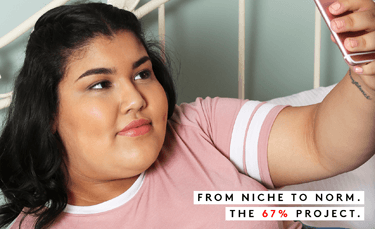
They also come to us because we have a broad offering. There’s 29Rooms, which is a live, interactive event that’s also a very shareable experience, and the 67% Project, which is an example of us working with brands to create mission-driven content.
That initiative is based off of the insight that 67% of women are size 14 and up, yet they’re not represented in media and advertising. We collaborated with Lane Bryant, Aerie and Getty Images to bring that issue to life. It’s the type of project we love doing because it allows us to make an impact and create a movement of sorts with brands that are aligned with our mission.
What sort of data is interesting to you, and how do you use it?
Data is only as good as the person reading it. It’s only useful if I have someone with a mind that’s adept to the nuance and able to think about the different ways the data can be interpreted.
I’ve worked with people who have said things like “From the data, it looks like our audience enjoys pictures of sunsets and doughnuts and the color X,” but that’s not useful, because how many pictures of sunsets and doughnuts are we realistically going to create? To me, it’s about the larger insight and learning, for example, that our audience responds to emotional imagery. That makes it both more applicable and more interesting.
It’s also instructive to find out which stories perform well and how we can recreate those archetypes in different ways. We do a lot of qualitative and quantitative research, and we experiment and make tweaks as we go along. We get an insight, we test it and we see where it leads before using it to inform our wider strategy.
Refinery29 launched its first app, a morning news roundup app called This AM, in February. How is mobile changing the way you function?
The This AM app was all about creating a new discovery tool to help people find Refinery29. For a lot of people, it’s their first entry into the brand. We have such a wide range of content, we decided that a news app would be helpful to the portion of our audience looking to stay informed on the day to day.
We know that 67% of our audience is looking at us on a mobile phone, and that’s had an immense impact on our content and strategy in multiples ways – everything from thinking about what content to post at what time of day to the way we format our content. All of our content is mobile-first because we know that’s how the majority of our audience is consuming us.









