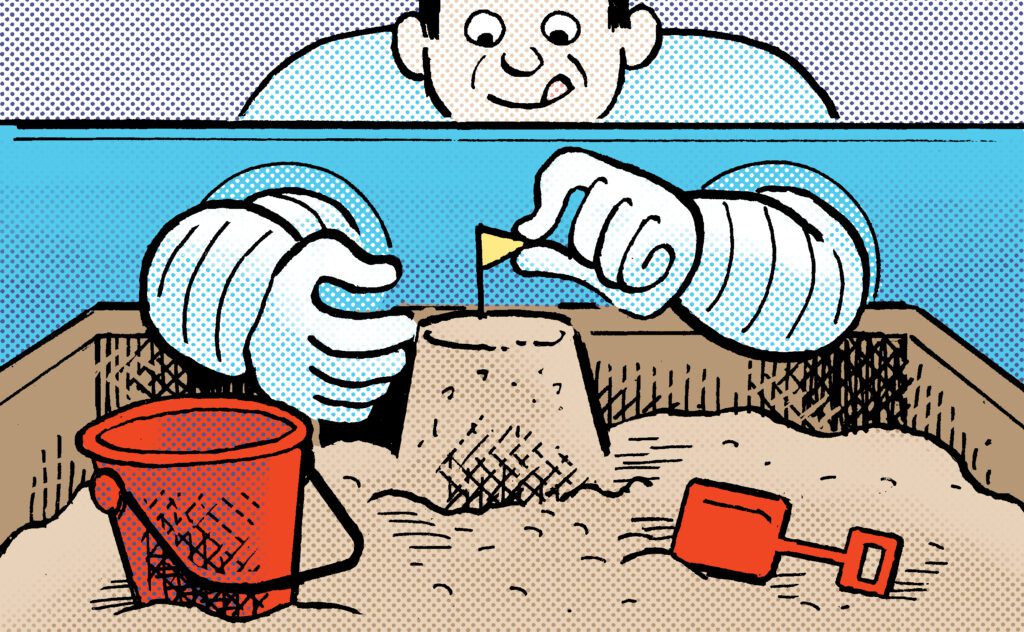
Deer fight with their antlers. Fencers cross swords on piste. Boxers unleash their fists in the ring.
Engineers do battle with reports and technical rebuttals.
On Thursday, Google published its response to a report released last week by the IAB Tech Lab’s Privacy Sandbox Task Force. (If you want to read the original report and Google’s responses in full, have at it here and here.)
The Tech Lab had found that the majority of basic digital advertising use cases are either impossible or impractical using the Chrome Privacy Sandbox APIs, including exclusion targeting, the use of VAST tags, budget pacing and second-price auctions.
Google, however, claims that many of these use cases are in fact supported and those that aren’t have been degraded on purpose because they “go against the privacy-preserving goals” of the Privacy Sandbox project, said Victor Wong, Google’s senior director of project management.
According to Wong, more than 90% of the 44 use cases analyzed by the task force are doable using the Privacy Sandbox APIs.

Building on sand
But to get the most out of the APIs – and “handle this transition to a strange new world” – ad tech companies will need to innovate and fundamentally change the way they work in Chrome, said Michael Kleber, a principal software engineer at Google.
“Ad tech is going to have to do something totally new – we’re not trying to whitewash that at all,” Kleber said. “But these are companies whose job it is to provide the infrastructure that makes the ad ecosystem work.”
Take lookalike modeling.
In its report, the Tech Lab notes that lookalike modeling and targeting is not supported and no suitable replacement exists in the Privacy Sandbox.
Google’s response is that if ad tech companies want to enable lookalike modeling, they should create a new mechanism to support it using technology in the Privacy Sandbox, such as the Private Aggregation API.
He said/she said/they said
Google also contends that there are inaccuracies in the Tech Lab’s assessment of the Privacy Sandbox.
- The Tech Lab, for example, says that exclusion targeting is blocked by the Protected Audience framework. But Google says there are no API restrictions to prevent showing ads to users that don’t belong to a certain interest group.
- The Tech Lab says that no available parameters contain information about other interest groups belonging to the same owner taking part in an auction, which means there’s no way for buyers to avoid bidding against themselves. But Google says there are fields to include signals that contain information about other interest groups from the same site owner.
- The Tech Lab says there’s no explicit way to get the information advertisers need to determine their budget and pacing in real time. But Google says that the Protected Audience API “was specifically designed for this use case.”
 And on and on.
Considering how much Google and the Tech Lab disagree about the Privacy Sandbox, it’s probably finally time to get these folks in the same room together.
Ugly baby shower
Google Ads was explicitly not invited to join the Tech Lab’s Privacy Sandbox Task Force during its fit gap analysis of the APIs.
The reason why, as IAB Tech Lab CEO Tony Katsur put it in a previous interview with AdExchanger, is because the Tech Lab wanted true candor. “Anytime you give product feedback,” Katsur said, “there is an element of telling someone their baby is ugly, and it can be uncomfortable to do that if they’re in the room.”
But now that the task force’s report has been published, Katsur said that Google is welcome to participate, and Wong told AdExchanger that he and the Privacy Sandbox team are all about it.
“I wish we’d be able to be there from the start to collaborate and make corrections,” Wong said. “We 100% want to get involved now, though.”
And in the meantime, the Privacy Sandbox team is open to recommendations and feature requests that potentially address some of the Tech Lab’s concerns, including improved support for second-price auctions and exclusion targeting.
No workarounds
But there are certain feature requests Google will not entertain – namely, attempts to use the Privacy Sandbox APIs to recreate cross-site tracking.
 “That’s just a no go for us,” he said.
For example, buyers want richer signals to base their bidding decisions on, as well as reporting showing all of the signals that were used to make a bid.
Individually, these are both very reasonable requests, Kleber said, but taken together they’d re-enable cross-site tracking.
“And that’s the fundamental thing we don’t want people to do,” Kleber said.
As flawed as they are, third-party cookies are just one signal that has been co-opted to do many things. The Privacy Sandbox contains multiple APIs, each of which supports only certain aspects of what third-party cookies were used for.
Fill in too many of the gaps, and we’re back where we started, Wong said.
“It’s like someone asks for cake, and you say no, you can’t have a cake. So the person says, ‘Okay, fine, can I have eggs? Can I have flour? Can I have sugar?” Wong said. “And then they say, ‘Oh, can I also have an oven, please?’”