

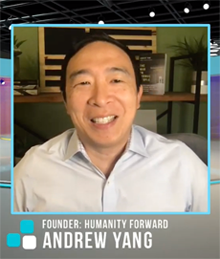
Former Democratic presidential candidate Andrew Yang has some feisty opinions about data privacy, Section 230 and social media platforms.
“They’re just trying to maximize their ad revenue,” Yang said at a virtual summit hosted by NYC Media Lab on Thursday.
Yang, who hasn’t ruled out a potential bid for NYC major, supports the idea that consumers should receive a share, or dividend, of the economic value generated by the use of their data. In June, Yang launched a program called the Data Dividend Project with the goal of creating a coalition of people to demand payment from the big tech companies that profit from the collection of personal data.
A few months later, Californians for Consumer Privacy, which is the nonprofit that helped shepherd the CCPA into law, appointed Yang as the chair of its advisory board. The group is now advocating for the passage of Proposition 24, the California Privacy Rights Act or CPRA, which is on the Nov. 3 ballot.
“It actually elevates the treatment of data and privacy rights in California up to a level that is right now happening in the European Union,” Yang said. “I believe it will pass.”
Read on for more of Yang’s hot takes.

On privacy policies
“Our data is getting sold and resold right now for over $200 billion a year, and we’re not seeing any of it. When we show up on Facebook and Instagram, there’s some strange thing we agree to in the terms and conditions and we have no idea what it says, We just agree and hope for the best. You think, ‘Well, it’s free.’ But it turns out that we are actually being sold and resold to the tune of tens of billions of dollars a year. And so the question is, what do we do now?”
On the Data Dividend Project
“If you join the Data Dividend Project … you’re just saying, ‘I want data rights to be the law and I will keep track of legislative action. But also, if there are class actions or ways that we can get paid for our data, then we can do so right now. Frankly, all of this stuff is abstract and confusing to most people. They’re just, like, ‘Oh, I hope nothing too bad is happening to my data.’ The hope is that we can actually get you excited. And one exciting development, for example, is that Facebook is paying a $650 million settlement to its users in Illinois right now, up to $400 a user, because they misused people’s facial scans … So, there are ways that we can actually get compensated for our data.”
On CPRA/Prop 24
“California voters really want this. … Many of the tech companies don’t like it, but they’re just, like, ‘I don’t know if we’re going to fight this one in time, because it’s hard to fight something that’s so clearly pro-consumer. If this thing passes in November, and I believe it will, it’ll sweep the country.”
On Section 230
“Section 230 was written in 1996. Think about how different the world was then. … You might have had a GeoCities bulletin board back then; Facebook didn’t exist. Any common sense American or legislator would look up and say, ‘We need better rules for this stuff.’ Right now, you have Section 230 that has been broadly applied to let social media companies off the hook for everything under the sun.
“And Facebook’s arguments strike me as so ridiculous. For a long time, they said, ‘We’re not a publisher, we’re a platform’ … [but] wait a minute, you’re literally the biggest publisher that ever existed by any standard. They’ve been trying to put themselves in this conceptual bucket so they can abdicate any responsibility. … Pretending you have no responsibility for any of this stuff is garbage. … Government has not done us any favors, because we’ve been relying on an archaic set of rules that could never have conceived of the world as it exists right now in 2020, and that’s why we need a change.”
On whether politicians understand technology
“On one side of things, these massive tech concerns are enormously profitable and valuable. And then on the other side, you have humanity. And who’s fighting for humanity? Theoretically, that would be the government. But the government doesn’t understand this stuff, because they don’t understand technology. The average age of a senator is 62 … they just don’t get it.”







