
 “AdExchanger Politics“ is a new weekly column tracking developments in the 2016 political campaign cycle.
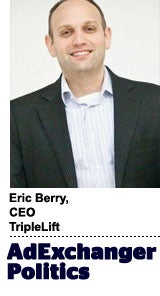
Today’s column is written by Eric Berry, CEO at TripleLift.
The political season is upon us, for better or worse. Cue the typical debates, false controversies, real controversies and, of course, ads.
But the 2016 presidential campaign is unique because it will be only the second election since the Citizens United decision set the stage for the creation of super PACs, whose significance, spend and scale have grown to unprecedented levels.
The massive flow of dollars that will hit political advertising channels will have an outsized impact on digital, which now accounts for roughly a quarter of overall ad spending in the US.

Social and native advertising have grown to such a scale that we will see meaningful divergence from traditional direct-response digital advertising. The two avenues will be used very differently, with social and native ultimately having the potential to be dominant forces this election cycle, and maybe even tilt the final results. However, due to several potential pitfalls, candidates and their super PACs should proceed with extreme caution.
Political advertising is an amalgam of marketing techniques. Direct response can be used extensively for donations and sign-ups but it’s not enough to win an election. The election itself is determined by swaying the minds of the roughly 7% of the undecided electorate, located in just a few meaningful swing states. Successfully influencing these voters’ perceptions of the candidates requires upper-funnel marketing, which is most effective from trusted sources, including friends or favored outlets.
As a result, I predict unprecedented growth in native advertising this presidential campaign season. Certain publications that bias toward the far ends of the political spectrum may accept sponsored content directly from the candidates themselves. For most digital publications, however, this may prove a bridge too far.
Editorials may endorse a candidate as part of a storied tradition in American politics. Native ads that appear to be a paid editorial endorsement for a candidate, however, have the potential to severely undermine the integrity of many publications. An editorial board’s ability to endorse a candidate based on its value system may be pitted against the publication’s desire for native advertising revenue. Certain notable publications have openly embraced this tactic and allowed full sponsored posts. But ensuring that this maintains the publication’s integrity requires a degree of finesse that most likely lack.
In turn, super PACs, and perhaps the candidates themselves, will focus “thought leadership” on topics relevant to the campaign’s talking points. Expect to see articles on gun control and other topics that espouse a particular side’s views, brought to you by some vaguely named super PAC.
The goal of this content marketing, and perhaps the sum of the presidential campaign’s marketing efforts, is for these 7% to be convinced by their friends and trusted sources. Naturally, social platforms – and the native advertising opportunities within each platform – will figure prominently. By further honing in on the 7%, strategists identify the demographics that overindex among the undecided.
Facebook offers great promise and potential headaches for political advertising. On the one hand, it biases users toward content that aligns with their inherent beliefs. This is a challenging concept for independent or undecided voters: Could Facebook’s algorithm end up unduly impacting the campaign?
On the other hand, the targeting and word-of-mouth content-sharing potentials are refined to a degree never seen in any medium to date. This again means content marketing to the adjacent targets, with a hope of indexing highly on the true targets, will be the objective of any effective native strategy on Facebook. Expect a massive influx of both campaign-direct and super PAC content-driven campaigns, all designed to be shared.
Twitter proved a strong content messaging medium in 2012. Notably, the platform does not filter content that appears in a user’s stream, nor does it have native advertising targeting based on demographic data. As a result, identifying and partnering with influencers in the appropriate demographic groups will continue to be a powerful strategy in 2016.
As for Snapchat, Vine and other platforms that may be fertile ground for native advertising, they are too nascent and don’t provide significant reach or advanced targeting analytics. Thus, political advertising will be limited to creative driven by an overarching understanding of each platform’s demographics, leading to moderated effort based on the reach and perceived ROI. Expect to see limited impact beyond a few awkwardly executed obligatory spots for each candidate that only appeal to their core demographics, serving largely as millennial outreach.
This election will feature the most digitally focused, expensive, data-intensive set of campaigns ever. The success of the Obama campaign’s use of big data in 2012 will be magnified by both parties in 2016. We will see personalized, content-driven campaigns distributed natively to the extent that any platform will accept it. The entire dynamics of the race could be determined through highly effective campaigns on Facebook, Twitter and native advertising across the web.
Follow Eric Berry (@ezberry), TripleLift (@triplelifthq) and AdExchanger (@adexchanger) on Twitter.







