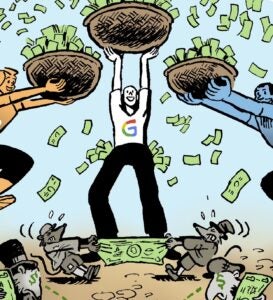
Mark Zuckerberg penned a lengthy post last week laying out Facebook’s vision for a “privacy-focused” future – but it’s not going to change Facebook’s business model.
Although Zuckerberg expends a lot of ink on the importance of data security and protecting messaging with end-to-end encryption, he doesn’t mention the interest and user-related data that powers Facebook’s advertising machine.
“It’s very loud, what is not said in that letter,” said Husani Oakley, EVP and director of technology and innovation at IPG agency Deutsch. “Personal data and the use of interest data isn’t discussed at all, and why? It’s not all that surprising. There still hasn’t been enough of an outcry – or a decrease in revenue or any massive migration away from the platform – for Facebook to even think about modifying their entire business model.”
Added Oakley: “Appears like it’s going to be business as usual.”
The end-to-end encryption Zuckerberg proposes doesn’t prevent Facebook from targeting people based on their public sharing, Oakley said. It just prevents Facebook, or anyone, from seeing what people share in their private communications.

Encryption aside, there’s still a lot of messaging metadata that Facebook could make available to advertisers, said Fatemeh Khatibloo, a principal analyst at Forrester.
Facebook might, for example, not know exactly what someone says to a brand in a private communication, but Facebook could easily see what ad that person saw right before DMing that brand, Khatibloo said, as well as how many times the person interacted with the brand and over what period of time.
“That kind of information is still plenty valuable,” she said.
And still plenty available. Although Zuckerberg pays “a lot of lip service” to the sanctity of privacy in his post, “it said nothing about a business model that is dependent on data collection for ad serving [and] it said nothing about whether Facebook would let people opt out of data collection for ad serving,” Khatibloo said.
At the same time Facebook is touting the significance of end-to-end encryption for messaging, which Zuckerberg calls “an important tool in developing a privacy-focused social network,” many of the moves Facebook is planning in the name of privacy have side benefits for, well, Facebook.
Facebook’s plan to connect the backend infrastructure of its messaging services, for example, which is partially a user experience play, could also be viewed as a way to help Facebook share data more fluidly across its platforms.
“They’d be able to see identity and platform usage without having to connect disparate data sources on their end,” Oakley said.
And if users can seamlessly transition between WhatsApp, Messenger and Instagram messaging, that creates a “lock-in” to the entire Facebook ecosystem, Khatibloo said, which could also lead to “some pretty serious disintermediation of the brand-consumer relationship.”
If Facebook, Inc. becomes the default platform for communication, nearly all consumer interaction with brands would happen there, from commerce to service, which “should be a bright red flag to every brand,” she said.
Baking secure communications into the platform could also be an attempt to head off regulatory woes by making data sharing across Facebook products into a legitimate business interest, Khatibloo said.
“I predict they will argue that now the platforms are all effectively one ‘product’ – secure messaging – and that breaking Facebook up will actually be bad for user privacy,” she said.
But what if, in that process, Facebook starts limiting the interest data it makes available to advertisers in a meaningful way? Well, that might just encourage advertisers to bring more of their first-party data to Facebook’s platform, said mParticle CEO Michael Katz.
“And brands would simply need to get better at using their own data to target people,” Katz said.