


Well, the other shoe dropped. Actually two shoes.
On Tuesday, the Federal Trade Commission and, separately, 48 attorneys general, led by New York’s Letitia James and including AGs from the District of Columbia and Guam, sued Facebook for the same thing: alleged illegal monopolization of the social networking market.
(Read the FTC’s full suit here and the states’ suit here.)
The bipartisan coalition of states collaborated with the FTC on its investigation, which first launched in September 2019, but the two lawsuits were filed independently of each other.
Both cases accuse Facebook of acquiring competitors in a predatory manner, squashing third-party developers, stifling innovation, degrading privacy protections in order to monetize troves of data and mistreating advertisers.
“This combination has allowed Facebook to maintain its monopoly over the social networking market and make billions from advertising,” James said during a press conference Wednesday announcing the state suit.

These cases come on the heels of the Justice Department’s recent antitrust lawsuit against Google and the House Judiciary subcommittee’s monster report criticizing the business practices of Google, Facebook, Amazon and Apple. Both dropped in October.
Here are the top takeaways from the complaints against Facebook.
Unfair to advertisers
Lacking meaningful alternatives to the advertising services Facebook offers due to its massive scale, advertisers “have been and continue to be deprived of the benefits of competition,” the states allege.
According to the state complaint, Facebook’s anticompetitive conduct creates a lack of transparency about Facebook’s reporting metrics, which advertisers can’t audit despite the fact that Facebook metrics have proven themselves to be erroneous and unreliable in the past.
“[Advertisers] are unable to ensure the same ad is not shown to the same person across media platforms,” the state complaint says. “Without accurate information about performance, advertisers cannot accurately assess the value of their ad spend on Facebook’s properties.”
AG James also noted that advertisers “have been subjected to higher prices” as a result of Facebook’s anticompetitive behavior.
Less privacy
James and Co. also argue that over the years Facebook has removed privacy protections in its quest to monetize data, “which is how they make money,” she said.
This removal has diminished the user experience on Facebook, the suit claims. The states point out that Facebook has steadily raised Instagram ad loads since its acquisition, more than doubling it between late 2016 and late 2019.
“Facebook puts profits ahead of consumer welfare and privacy,” James said.
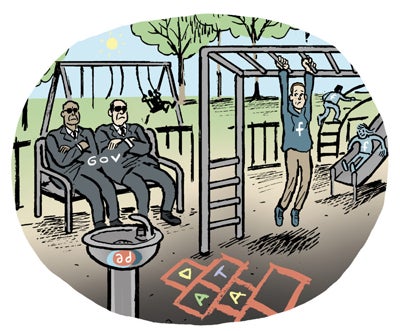 Snuffing out innovation
Both the states and the FTC zeroed in on Facebook’s acquisitions of Instagram, for $1 billion in 2012, and WhatsApp, for $19 billion in 2014.
According to the FTC’s complaint, Facebook targeted these companies because they were competitive threats to its dominance.
Facebook initially tried to compete with Instagram, but ultimately decided to buy it for an eye-watering sum, even though at the time Instagram hadn’t made a cent in revenue.
A similar scenario played out a couple of years later when it became clear that WhatsApp was emerging as a category leader in mobile messaging. Rather than compete, Facebook neutralized its competitor with googobs of cash.
The moves reflect Mark Zuckerberg’s view, expressed in a 2008 email cited by the FTC, that “it is better to buy than compete.”
‘Open first, closed later’
Facebook is also accused of imposing anticompetitive conditions on third-party software developers using its APIs. Facebook has made these APIs available to third-party apps on the condition that they refrain from developing competitive functionalities and from connecting with or promoting other social networking services.
The FTC points to Vine as a salient example. When Twitter’s Vine started to take off in 2013, Facebook shut down the API that would have allowed Vine to find Facebook friends.
James referred to this as an “open first, closed later approach.”
After benefiting from whatever functionality and engagement a third-party app brings to its service, Facebook could “abruptly cut off the apps it viewed as a competitive threat,” she said.
“Some of these companies experienced an almost overnight drop off in user engagement and downloads and their growth stalled,” James said. “This also sent a clear message to the industry: Don’t step on Facebook’s turf or, as one industry executive put it, ‘You will face the wrath of Mark.’”
What’s next?
Both lawsuits are calling for the courts in which they were filed (federal court for the FTC and the US District Court for the District of Columbia for the state complaint) to permanently stop Facebook from engaging in allegedly anticompetitive behavior.
This remedy could take multiple forms, including requiring Facebook to seek prior notice and approval for future M&A and barring Facebook from imposing anticompetitive conditions on software developers.
A potential breakup isn’t off the table either. The FTC and the state coalition are both seeking a divestiture of previously acquired assets, including Instagram and WhatsApp.
“It’s critically important that we block the predatory acquisition of companies and that we restore confidence to the market,” James said.








