Millennials are all about streaming on the sofa, but that doesn’t mean they don’t still go to the movies.
The addressable audience in movie theaters is massive, said Jerry Canning, VP of digital ad sales at National CineMedia (NCM), a cinema advertising network that curates pre-show featurettes, movie news and trivia across more than 21,000 screens and 1,700 theaters in the United States.
More than 750 million people watch movies at AMC, Cinemark, Regal Entertainment and other theaters under contract to present NCM’s pre-show content.
“Marketers are looking for scale, which is why they keep coming back to TV, but they’re also looking for a millennial audience, and that’s what we have,” Canning said.
NCM is also adding more plum inventory opportunities, including a 60-second spot that runs between the trailers.
“We’re thinking of it as almost the equivalent of a Super Bowl ad,” Canning said. “Blockbusters are tentpole opportunities, and this is a chance to reach people when they’re sitting back and the lights are down.”
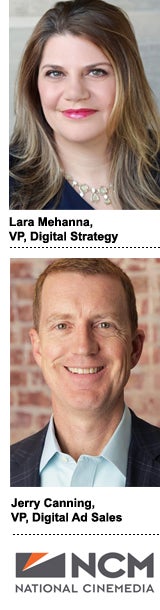
AdExchanger spoke with Canning and Lara Mehanna, VP of digital strategy.

AdExchanger: Who goes to the movies, how is that changing and what challenges do those changes present to advertisers?
JERRY CANNING: The average age of theatergoers is actually relatively young – 31 – and that number has not really changed much, although the average age of cable and broadcast viewers both continue to inch up. Moviegoers are an audience of millennials, of cord cutters and, in some cases, cord-nevers, which can be hard to reach, and that is very attractive to marketers.
How do you engage with that audience?
CANNING: We think about opportunities to engage through digital products before people come to the theater, when they’re in the theater and after they leave.
For the in-theater experience, we have our trivia platform and games that create interactivity between the big screen and a person’s phone, and we have a site called noovie.com where you can see trailers, showtimes, behind-the-scenes info on movies and buy tickets. We’re investing a lot in our content strategy to try and create opportunities for people to engage throughout the day.
What does this do for advertisers?
LARA MEHANNA: The in-theater pre-show is a great opportunity for advertisers to capture attention when people get there a little early. Sponsorships are sort of a default opportunity, but advertisers can take it to the next level by using technology, like augmented reality or immersive reality, on top of video running in the theater where they can incorporate their brand.
CANNING: Cinema is a great branding platform. It’s a 50-foot screen and a captive audience. But we’re also investing in building out audience insights so we can gather data from these interactions, which brands can use to understand the effectiveness of their campaigns and, eventually, unlock attribution.
How many people actually show up early to the theater?
CANNING: We’ve measured our traffic through Nielsen. The weekend audience translates to a Nielsen rating of more than 8% in adults 18 to 49, which is higher than Sunday Night Football or “This Is Us.” Yes, we’re aggregating audiences across multiple screens, but I think it’s a fair comparison, because we can reach an audience in a two-day period that is more than comparable to the scale of television.
Are theaters threatened by streaming?
CANNING: It’s a reality that people are migrating to streaming, but it’s also a fact that the heaviest consumers of streaming content are the same people who go to the movies a lot. There’s a study from Ernst & Young to back that up. And so it’s not a zero-sum game. People who have an appetite for content in general will go to the theater for a big premier one day and stream a series the next.
MEHANNA: There’s a social aspect to going to the movies. People are buying their tickets to big blockbusters in advance, breaking ticket records and getting there early even if they already have tickets. When a big movie comes out, people still want to see it in the theater.
Even so, will streaming services be allowed to advertise on the big screen through the NCM network?
CANNING: We see streaming companies as partners. Our pre-show is comprised of content blocks and ads. If you look at who is supplying that content, in many cases, it’s a streaming company. And so, yes, we partner with them and they utilize our screens.
How do you price the ads in your ad network?
CANNING: We take a CPM-driven approach, and buyers can target by parameters like genre, rating or specific title. Although we do have the capability to deliver digital ads down to an individual’s screen, which we often do for local advertisers, we generally sell on a run-of-network basis. It’s a managed service that you buy through a sales rep. The commitment is made through IOs and we book the inventory.
Is programmatic on the road map?
MEHANNA: It’s something we’re working on, to create more fluidity for our inventory across all screens. We’re making investments into in-house technology, but it’s complex. We need to make sure that the theaters are ready.
We’re also soon releasing new capabilities to help advertisers tap into our audience in a more programmatic way.
How so?
CANNING: As we’ve developed digital properties, we’ve started to understand our audience better and collect permissioned data. As a result, we’ve been able to build more than 70 million data sets related to moviegoers, and that’s growing. We project we’ll be close to nearly 100 million by the end of the year.
This data will give us the ability to deliver customer segments to marketers, who can first reach audiences on a big screen in theaters and then generate frequency or retarget on digital.
This interview has been edited and condensed.