
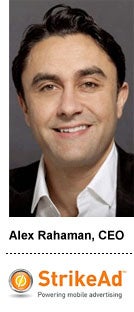
 Both mobile ad spending and real-time bidding are growing rapidly, but for many advertisers, whether there’s enough scale to justify a major investment in either of those formats remains a question. Mobile demand side platform StrikeAd is hoping to promise enough scale for mobile buyers by simultaneously stretching its operations from its original UK base to its new headquarters in New York and an outpost in Southeast Asia.
One thing that has held back mobile RTB is the primary focus on geo-targeting, which is nice for local businesses (who, incidentally still don’t spend all that much on digital), but not so great for national brands (who are spending many millions on interactive ads). In the next few weeks, StrikeAd will unveil a new mobile behavioral targeting offering, which CEO Alex Rahaman, who previously ran the publisher-facing Unanimis (Orange) Mobile Ad Network in the UK, believes will give the mobile RTB space even more of a boost.
AdExchanger: Why did you decide to pursue an exchange business focusing on mobile?
Alex Rahaman: Back in 2010, the demand side space in mobile was indeed just emerging. Having taken a mobile publisher, Orange, to agencies, we found that the site wasn’t getting enough scale. We couldn’t figure out what the problem was – it had great data, great traffic. But agencies were confused by the marketplace. You had a lot of new, unknown, undifferentiated brands springing up at them at the same time. The agencies also didn’t have substantive tools or methods for tracking and understanding the ROI of their campaigns.
Secondly, I knew if I was going to launch another business, I didn’t want to do another sell-side focused company again. It would have to be a business aimed at working directly with the agency and the advertiser.

Okay. But what’s the value proposition for mobile RTB at this point in time? How strong is the interest from the marketplace in a mobile RTB solution right now?
We were one of the first to go live with Nexage with AdMeld with mobile buying via RTB in May 2011. We have since done 15 other similar integrations with companies and licenses with major agency trading desks. We currently have self-serve options in the UK and U.S., and in our just-opened Singapore office. So the answer is, simply, we’ve seen where the market has been headed for a long time.
As you work to build your U.S. presence, why launch in Singapore as well? Is it a reflection of how mature the mobile market is in Asia?
Singapore is a very UK-friendly environment. It’s a highly ranked place to do business. Most large media agencies that we work with have offices there to cover the Southeast Asia region. We’re really servicing agencies that have reached out to us from the UK. At the same time, we also have a licensing deal with mobile media agency owned by Japanese ad agency Hakuhodo there. Having an operation in Singapore helps us serve that area as well.
Looking at the growth of programmatic buying, I would split Asia into three distinct markets: China, Japan and Southeast Asia. Japan is the most advanced in the mobile space, as the U.S. only recently surpassed Japan as the largest mobile market. So there’s about $1.5 billion in mobile ad spending in Japan. So programmatic buying is accelerating quickly in Japan. It’s comparable to the UK, but not the U.S. Everything tends to revolve around activities from the two major Japanese ad firms, Dentsu, which works with OpenX, and Hakuhodo. There are a few companies in Japan that call themselves DSPs, but they’re not fully fledged.
So Tokyo and Singapore are the hubs for the emerging RTB space in Asia, with Beijing and Shanghai starting to move forward.
So is the main force driving programmatic buying in Asia simply a reflection of the embrace of RTB in the west? Is it just a natural extension? Or is there anything in particular in the Asian region that’s either contributing to or holding back the adoption of RTB?
The only real difference is that the PC/digital market is not as mature as the west in terms of percentage of ad spending. That said, a larger portion of Asian consumers are using the mobile web and apps for their media as opposed to using their PC. So I think mobile RTB-based ad buying methods will rise quickly, since there’s a greater degree of parity between PC users and mobile users in Asia, as compared to the west.
What are your U.S. expansion plans?
We’ll be hiring in Chicago and next month, we’ll be launching a partnership with a mobile DMP to look more closely at behavioral targeting. We see that as a huge opportunity. The partner is in stealth mode at the moment. Up to now, we’ve worked with location-based DMPs like PlaceIQ. But behavioral targeting hasn’t been much of a focus on mobile. But that’s changing.
Follow Alex Rahaman (@alexrahaman) and AdExchanger (@adexchanger) on Twitter.






