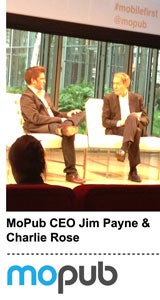
 It’s been a big year for mobile ad exchange MoPub. The 3-year-old company opened new offices in London, Singapore and New York, reached a revenue run rate of $100 million and was acquired by Twitter.
In its first New York City conference today, CEO Jim Payne sat down with talk show host Charlie Rose (who twice referred to the company as “moped”) to talk about the sale to Twitter, mobile advertising trends and the company’s next steps. Read on for highlights of their conversation.
CHARLIE ROSE: When the opportunity came from Twitter, did you say, “I know some people that went that route and got lost or some that turned it down and then got lost?”
JIM PAYNE: Entrepreneurs live in fear of passing on an M&A and your business goes south. When Twitter came around, it was not the first opportunity we’d had to sell the business, I’d walked away from a number of deals in the past. The Twitter deal was one I was intrigued by enough to keep digging. You keep turning over cards and enough things lined up where we said these guys are cognizant of the opportunity to build a great advertising ecosystem focused on mobile. And the economics worked.
MoPub is the first comprehensive program for mobile apps. What do you mean by comprehensive?
We set out to provide a product for someone who’s making an app that lets them manage their ad business through our platform. That means ad network management, analytics and data on what people are looking at. And we built an exchange on top of that. We wanted to provide an open place for buyers to come together.

How did you do that?
Well, we were providing standards and things like that, and we moved everything to the server side. The initial world in which we operated had a lot of complexity on the device. If I requested an ad, I’d go to different ad networks, and so we moved a lot of that logic to the server side to make it as simple as possible.
Is there something that became bigger than you expected and is there something that didn’t pan out?
I expected programmatic to be faster. I thought the desktop guys would quickly adopt mobile but it took us a lot longer than we expected and it’s because we needed to create that ecosystem.
The first companies that connected to our exchange on the buy side were companies that were not coming to us from desktop but were completely brand new mobile-first companies. They’re the largest participants in our exchange and that was a surprise to me. We also tried a number of things that didn’t pan out. We’re still trying to figure out native advertising.
Can you build a moat in technology?
It’s very hard, but I think the most powerful moat is the power of network effects. I was always biased toward businesses that have that. I think that’s one of the most powerful and compelling things about Twitter’s ecosystem. That network effect is so strong that it would be hard to replicate even though plenty have tried.
What follows mobile?
I don’t know the answer to that. I remember in 2006 people were asking what’s next and then the iPhone showed up. I don’t know if anyone in 2007 said, “This is going to be a revolution.” I think it’s still early days. We’re just crossing the point where there are more mobile users than desktop users and smartphones and tablet shipments bypassing desktops has just started happening.
Did Twitter come to you or did you go to them?
They came to us. One of our guys introduced me to [Twitter CRO] Adam Bain. I took two folks with me, [platform VP] Herman Yang and [VP of sales] Kevin [Weatherman]. The three of us met Adam and [VP of revenue products] Kevin [Weil] from Twitter. We were very skeptical about whether or not they had the appetite to do something really big. But afterwards I remember going to dinner that night with Herman and saying, “This is making a lot of sense.”
MoPub’s identity might be challenged by its acquisition by Twitter. … How are you sure that your identity will remain strong?
Going into a big company, you do start to lose that sense of autonomy but Twitter doesn’t have an incentive for us to melt away. They want and need to build an ad-tech business. Marketers are hungry for access to Twitter users. We add a tremendous amount of strategic value there and they don’t have anything like us internally. The value that MoPub provides is in our publishers and their inventory, so it would not be in their interest to let that go.