 Some people might describe Foursquare’s shift from location-based social network to a purveyor of location data as a pivot.
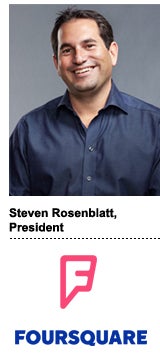
But Steven Rosenblatt, newly appointed president of Foursquare, prefers the term “evolution.”
“We’ve been building the world’s largest location intelligence data company for some time,” said Rosenblatt, who came to Foursquare in 2012 after several years as director of advertising sales and strategy for the now soon-to-be-defunct iAd, having joined Apple as part of the Quattro acquisition.
Rosenblatt was bumped up to president of Foursquare on Jan. 14 after four years as CRO.
Last week was an eventful one at Foursquare. In addition to Rosenblatt’s news, company co-founder Dennis Crowley relinquished his CEO duties to Jeff Glueck, who came on board in 2014 as COO, and announced $45 million in Series E funding led by Union Square Ventures, brining its total to over $166 million since 2009.
The round reportedly valued Foursquare at $250 million – far lower than the roughly $650 million valuation it received during its last round in 2013.
Rosenblatt is unruffled.
“Up round or down round, there aren’t that many companies that could raise $45 million in this environment,” Rosenblatt said.
While Foursquare still operates two consumer-facing apps – its titular offering for recommendations and location discovery and a second app called Swarm for check-ins – most of its revenue comes from a combination of ad tech and enterprise solutions, both of which saw more than 150% growth year over year, Rosenblatt said.
Foursquare has roughly 55 million monthly active users, as well as geofence data on 65 million locations around the world and a database of location info built off of 8 billion check-ins.
AdExchanger caught up with Rosenblatt on his second day in the president’s seat.

AdExchanger: What is Foursquare’s value prop in a nutshell?
STEVEN ROSENBLATT: We’re the only company out there with first-party location data that’s been built from how the phone sees the world, and we have enough data that we can also determine location in high-density areas like cities or specific stores in a mall.
Eight billion people have told us that their phone is in a place, and we have 100,000 developers that we get data from.
How does Foursquare handle the known issues around location data accuracy?
We have deterministic data, not probabilistic data. There are a lot of fundamental flaws if you’re just an ad tech company trying to make sense of location data. If you don’t have a ground truth, you don’t have anything.
What do you think about other location data companies? There are a lot of them.
There’s going to be a big shakeout in this space. The only other companies that have real first-party data are Google and Facebook, but they don’t have consumer confirmation – a consumer actually telling you, “I am here, in this place.”
Geotargeting by state, for example, is broad enough that you’re not going to make much of a mistake, but a lot of other companies are making assumptions because they’re using proxies. GPS data bounces. Cell phone triangulation is so inaccurate.
Take Mall of America. Outlying signals may allow a phone to know it’s in the mall, but there is no way that those other companies could, with any degree of accuracy, understand which store someone is in.
How do you keep your location data fresh?
More people are actively checking in now than ever before, so we’re constantly getting fresh information. And we know when places open and close because the crowdsource community is faster at figuring that out than anyone else. We also have 100 million Wi-Fi scans, and we have a core technology built into our app called Pilgrim that creates a passive record of location, snapping users to places whether they’ve checked in or not.
What are Foursquare’s main revenue sources?
We have two major lines of business that form the lion’s share of our revenue: media and enterprise.
On the media side, we built Pinpoint to be a massive platform for digital targeting in the real world which allows marketers to reach audiences of non-Foursquare users based on where they go programmatically on any device. It’s the location equivalent of cookies.
We process location data from partners and we’re able to confirm whether it’s accurate or not because we have an always-on panel of users, and we’re plugged into all the major exchanges. AppNexus, AdX, Drawbridge and Adelphic are our preferred partners.
On the enterprise side, we have a developer platform subscription business for companies that want to access our API, which is moving toward a SaaS model.
We also have our place insights business to provide information around foot traffic and business intelligence around things like lift and exposure.
Does the market “get” Foursquare and what it’s all about?
We’re the most misunderstood company in the history of technology. That’s really our major challenge. Everyone wanted us to be the next Facebook. Well, we’re not the next Facebook, but we’re in the 1% of startups that make a success of themselves, and we’re thriving.
Is location data and its uses also misunderstood?
Anyone else who tells you they can use deterministic data programmatically while sitting on top of an ad exchange to reach someone in real time in a particular place is just full of shit. That is not truly happening. They’re making a complete guess, and we know this because of our consumer database and because we sit on exchanges, so we can see location data coming in – and at least 80% of what’s being passed isn’t accurate enough to snap someone to a particular place.
Any plans to IPO?
We’re just coming off fundraising. Our goal now is to put our heads down with the new funding, meet the demand that’s out there and get to profitability. From there, we’ll see.