

 Entrepreneur and paid-search pioneer Bill Gross, who in 2003 sold search company Overture Services to Yahoo for $1.6 billion, has set his sights on a new venture: mobile advertising.
Gross’ mobile ad firm, UberMedia, started as a developer of free utility apps in 2010 before transitioning into mobile advertising last year because it needed a revenue model. The company is part of Gross’ business incubator, Idealab – an umbrella company in which UberMedia is the largest component.
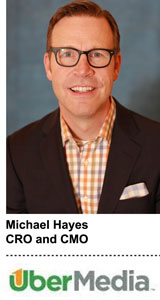
“We’re no longer a product innovations company, we’re now an ad company that plays in the programmatic, data-infused advertising space,” said UberMedia CRO and CMO Michael Hayes. This has altered UberMedia’s competitive landscape, which includes Millennial Media, Jumptap [recently acquired by Millennial], iAds, Twitter, Facebook and Google.
UberMedia unveiled its UberAds platform last spring, which targets ads based on social signals and location data. And, according to Hayes, the Pasadena, Calif.-based startup is still in growth mode and not yet profitable, although it has raised $26.2 million to date. AdExchanger spoke with Hayes, who was the former president of digital communications at ad agency Initiative before joining UberMedia in July.
AdExchanger: What does UberAds consist of?
MICHAEL HAYES: Everything about the technology is owned by UberMedia, including the data. What that means is we’re not licensing any third-party data and none of the technology is licensed. The tech stack was built by Bill and our team, which includes our own ad server, an RTB platform that connects into exchanges, as well as bidding tools and real-time recording and optimization algorithms. Our technology was built from a mobile perspective, as opposed to companies like Turn or Rubicon Project, which started with desktop banner ads.

We’re not a content play. Even though we own some of our own inventory, we also get inventory from the ad exchanges. We also just hired some folks in the US for our direct-sales effort, although only a small portion of our revenue comes from direct ad sales.
Where does your ad inventory come from?
We get inventory from our owned and operated applications, a partner network and ad exchanges. The owned and operated part includes our apps like Echofon, Plume and UberSocial’s app. The next chunk comes from things we operate on behalf of app developers in our partner bucket, which also provides inventory for us. And then we also have exchange-based inventory.
What are the splits between in-app, mobile Web and desktop inventory?
The majority of it is in-apps advertising. In-app inventory represents about 70% of the inventory that we’re running. We do run ads across different screens including tablets, desktops and smartphones, but most agencies come to us for their mobile inventory since they already have desktop inventory.
What targeting capabilities do you offer?
Our targeting is based on a combination of social data, interest-based data and location history as well as sentiment analysis and behavior we’ve analyzed across smartphones, tablets and desktops, as well as frequency and time of day and a few other data points.
We get the social data from our first-party apps like Echofon, Plume and several others. We’re not licensing data from BlueKai or Experian and the other third-party data providers that our competition tends to license.
What is the advantage of sticking to first-party data?
When I was on the agency side, what I found was that it was very difficult to determine what was in the third-party data. I could never tell what was working and not working in the data sets.
If someone told me they have 300 data providers, that was great but I didn’t know what that meant. I had no transparency into the data and an agency trading desk can get that data as well, and so it wasn’t unique.
The main advantage of having first-party data is that it’s unique and it usually performs better. From a publisher or supplier standpoint, we have transparency into what’s working and not working because it’s our own data and we can provide those insights to the publisher. That tends to resonate with agencies, because they’re trying to make better media investments and without that transparency it’s difficult to do.
How do you compete with Twitter’s move towards providing more ad-targeting tools?
We do things Twitter doesn’t do and Twitter does things we don’t do. Because we have access to all that first-party data from people using our apps, we have a large database of device IDs and Twitter handles. We have over 400 million device IDs that have on average 77 data points and we acquire 30 million device IDs a month.
With that, we can do what we call follower targeting, which combines social targeting with interest-based targeting and location history using data from ad-supported apps. These data streams are not siloed, and when you combine them, we can serve rich media including video ads across different devices.
If you wanted to reach college football fans, for example, we can target followers of the coaches, players, bloggers and fans, and then in terms of interest, see who has ESPN and other sports apps installed on their phone. The location history tells us who’s in the stadium and who’s tailgating. If you combine all those audiences together, we are significantly larger than ESPN.com. Twitter isn’t really offering those kinds of ad buys, but they could in time.
What are your thoughts on Facebook Exchange?
We don’t really compete with Facebook in the same way that we do with Twitter. The best advertising is contextual-based advertising, which is why paid search works so well. When you’re on Facebook, you’re there to interact in a social environment, so their ads are not that contextual.
Facebook’s CPM rates are also fairly inexpensive when you compare them to CPMs for paid search or other players. Then again, Facebook does have a fantastic data set, so I still expect them to become a viable advertising force, as well as Twitter.
But to bring it back to UberMedia, from a buyer’s perspective, you want alternatives to Google, Facebook and Twitter. Consumers consume content in many different ways so smart buyers want to diversify their media planning.
What are you looking to accomplish over the coming year?
We need to be well-known. We have a very good story, but we have low awareness. In addition, we need to continually innovate in closing the loop in marketing. A lot of the “closed loop” part is in the physical world and mobile gives you a unique advantage to do that. We want to close the loop for advertisers to show them what’s working and what’s not with things like visit rates and how their marketing spend is performing, so that’s where we are right now.








