Facebook’s big bet on messenger bots was an oversell from the start.
What’s shaking out now is a more reserved and perhaps more useful idea of what a bot can be and how a business can use it.
“Rather than having chatbots be ‘the star of the show,’ as was the implication last year, Facebook is shifting to offer ‘bots as helpers,’ which is a truer representation of where bots are today,” said Rurik Bradbury, global head of research at LivePerson, an enterprise messaging tech company.
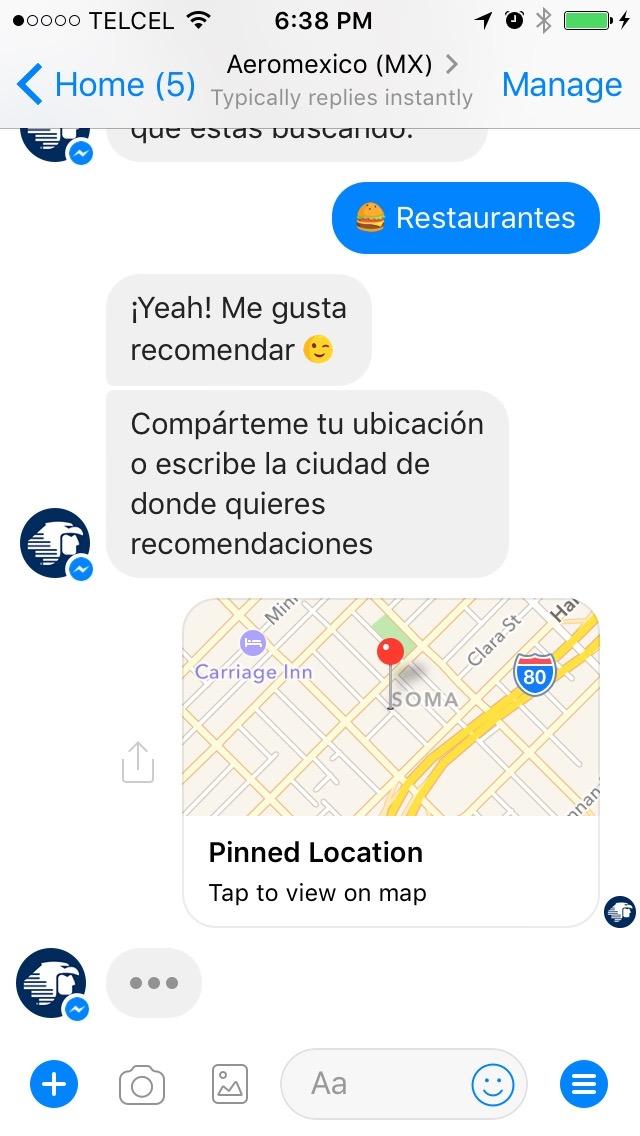
Aeromexico is a good example. Last year, the Mexican airline launched Aerobot to automate the simpler, more tedious aspects of customer service.
Roughly 80% of the questions coming into its call center – “When is my flight?” or “How do I change the name on my ticket?” – could be handled without a phone interaction.
“We’re not trying to get rid of customer service agents,” said Brian Gross, Aeromexico’s VP of innovation. “We’re clearing the easy questions and making the process of getting answers easier.”
Aeromexico worked with two partners – machine-learning company IV.AI and bot creator Yalochat.com – to ingest historical data from all of its customer service channels, everything from tweets and Facebook chats to email history and the conversations customers had with reps through the soon-to-be retired web chat widget on Aeromexico’s site.

Six months in, around 35,000 Aeromexico customers per month engage with Aerobot, and the bot’s been able to reduce the time required to resolve a service query from 16 minutes to two. The bot also provides destination-related recommendations and a group booking feature.
Aerobot has its limitations, though. While the bot learns from interactions – it’s able to respond, for example, when a familiar query is asked in a new way – it can get flummoxed by questions it hasn’t been previously exposed to. When the bot is presented with a question it can’t yet answer, the conversation is diverted to a live customer service rep.
Aeromexico and its partners are working on expanding the bot’s repertoire by adding more questions and answers to its memory bank.
A disconnect still exists between the future-looking conception of bots as AI-powered self-learning virtual assistants with all the answers and the reality of bots as the most boring – but potentially the most helpful – person in the room.
They’ll aid you in the execution of simple tasks, like easily inputting bank information, organizing emails, changing travel plans, scheduling meetings and aggregating links. But the ability to converse in natural language is still very much a work in progress.
Computers are often “confounded” by basic questions “because they don’t understand the world around us,” said Facebook CTO Mike Schroepfer at F8 in San Jose last week. “With all of the promise of AI, the bots and assistants we have don’t seem to be able to answer most of the questions we ask them.”
But bots also face a more prosaic problem: discovery. About 100,000 bots are active on Facebook Messenger, but until recently there was no easy way to find them. At F8, Facebook announced that it is rolling out a dedicated Discovery tab within Messenger, including a search bar, featured bots and recently viewed bots. (Think app store for bots.)
 The new discovery tab will accelerate mainstream bot adoption, said Brendan Bilko, head of product and creative at Dexter, a DIY bot-building platform that’s done work for Sony, GE, McCann and others.
Bilko points out that most people have probably interacted with a bot already, whether they know it or not.
“If you’ve donated to a cause via text or set a reminder in Slack, you’ve engaged with a bot,” he said. “These are merely simple pieces of software we communicate with to execute a task. If you can bring genuine utility or entertainment to someone where they are already spending their time, they’ll be interested.”
But the hype cycle didn’t do bots any favors.
“Today, many experiences are still frustrating because they don’t really save time or take consumers’ context or past experiences with the brand into account,” said Thomas Husson, VP and principal analyst at Forrester.
That said, bots are gaining traction. Although only 4% of marketers interviewed by Forrester are regularly deploying bots today, 35% are piloting or plan to pilot bots in the next 12 months.
And use cases are emerging.
SnapTravel is a part-bot/part-human hotel booking service that lets people reserve rooms through SMS, Slack or Messenger. The company, founded last year, has driven $1 million in revenue through Facebook Messenger alone and it’s seeing 20% month-over-month growth, said SnapTravel CEO and co-founder Hussein Fazel.
Epytom, a stylist bot that sends personalized daily recommendations on what to wear, sees 65% retention among users three weeks after their first engagement. The industry average retention rate for apps after 30 days is 36%, according to Localytics.
The key to bot success is simplicity, said LivePerson’s Bradbury. Brands that overpromise in this space inevitably will underdeliver.
“Bots need to be specialized, they need to have a particular job and do that job really well – and it has to be a job that consumers understand so they know what to expect,” Bradbury said. “With this as the base, the use case for bots can expand into any routine or tedious task that usually takes someone extra time to do.”