

Marketers, forget virtual reality (VR) for now. VR and augmented reality (AR) often get lumped together, but AR is the consumer-facing technology that’s taking center stage.
At a special event on Tuesday, Apple unveiled an assortment of new hardware and software, including iPhone 8, souped-up Apple TV, the next generation of Apple Watch and a soon-to-hit exclusive iPhone with an edge-to-edge display.
But ARKit, Apple’s suite of developer tools and frameworks for augmented reality, is where the value lies for brands.
“This is the first iPhone really created for augmented reality and the first smartphone designed for it as well,” said Phil Schiller, Apple’s SVP of worldwide marketing.
Through ARKit, “the camera becomes the new home page,” said Tom Edwards, chief digital officer at Epsilon. “Brands can now easily take advantage of new branded filters, 3-D camera functionality and augmented reality settings to entertain Apple users.”
IOS 11, Apple’s latest operating system set to be released for public download on Sept. 19, places Apple in a position to “change AR from a novelty to a viable marketing vehicle,” said Wendell Lansford, co-founder of social marketing platform Wyng.
“With ARKit included in iOS 11, Apple’s iPhone will be the device with the most AR apps – and the most creative AR apps – reaching the most people,” said Lansford, pointing to the vastly increased reach Apple will foster by introducing ARKit within its developer community.

Some applications of AR are obvious, like gaming and sports.
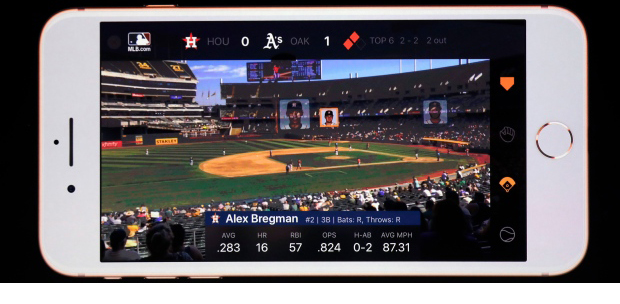
Augmented reality enables gamers to use photo mode to bring game characters into the real world or to superimpose stats and real-time player info at or during a sporting event, as the MLB Advanced Media team is doing with its At Bat app, Schiller said.
But the brand use cases are also self-evident.
“With AR, brands have the potential to fundamentally redefine their current physical customer experience,” said Paul Kelly, CRO of sports media company Whistle Sports. “The implications for physical retail are profound.”
Imagine being able to hold up a phone and see a piece of furniture from all angles or “putting on” a suit and seeing how it looks from the front and the back before adding it to the cart.
“Products become so much more tangible,” said Tim Keelan, VP of solutions consulting at personalization platform Sailthru. “And interacting with a product helps get people further down the line toward a purchase.”
The concept of tapping into AR to help consumers engage with a product before purchase isn’t new. Warby Parker, for example, has let people try on virtual glasses online for years, and since 2013, IKEA has allowed consumers to scan its physical catalog and get virtual previews of how furniture will look in their home.
But now the tech is getting better – and so is the adoption.
“There’s been a maturation of the technology – it’s better, crisper, faster – and a maturation of the audience as well,” Keelan said. “People of all ages are ready to accept the technology. Ten years ago my mother, she’s 72, would never even go on a computer. Now she’s on an iPad interacting with brands, messaging them and emailing them.”
The value of more seamless and ubiquitous augmented reality functionality, however, will come to brands that use it to enhance experiences rather than as a pure advertising vehicle.
“AR combined with computer vision, location, psychographic data and AI-driven virtual assistants will ultimately recreate our view of reality,” Edwards said.
And when multiple tech giants start throwing their weight behind something – augmented reality was also a major theme at Facebook’s F8 developers conference in April – brands need to perk up.
“AR is here to stay because, ultimately, it will serve a real utility beyond an innovative advertising experience,” Kelly said. “It will satisfy our need for specific information at a specific place and time – at all times.”







