 The race to reach consumers on mobile devices has advertisers juggling a mountain of data as they try to deliver relevant ads.
Mobile ad network AdTheorent, whose clients include Samsung, Pepsi and IBM, argues that weather conditions, along with other data points, should be included in ad-serving decisions.
AdExchanger spoke with CEO Anthony Iacovone about the role that predictive modeling and weather conditions can play in helping brands and advertisers deliver targeted mobile ads.
AdExchanger: What does AdTheorent specialize in?
ANTHONY IACOVONE: We’re a data science company disguised as a mobile ad network. When we make decisions on whether to serve an ad or not, it’s based on predictive technology. What that means is we look at lots of data on a real-time basis and then our system, which we call the Real-Time Learning Machine, makes a decision on whether or not to serve an impression based on different variables.
What led you to include weather conditions in your ad-serving decisions?
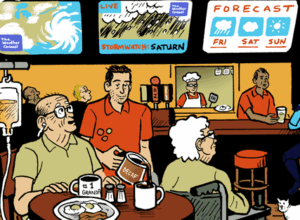
Weather is a big component of the data that we look at. Before we serve an ad, we always look at the weather condition of the region including humidity, temperature and precipitation. Lots of studies have shown connections between overall human behavior and weather.

But it’s not as simple as hot weather equals more clicks. It’s also about regionalizing that behavior and looking at weather trends to understand how individuals in various parts of the country tend to react to different weather conditions.
For example, when it’s really hot, it affects people differently in different parts of the country. We tend to see that hot weather in New York drives a higher CTR, but high temperatures on the West Coast have an adverse effect on CTR. So we take that into consideration when we serve an ad.
What effect did the polar vortex have on deciding which ads to serve?
The southeast region has shown to be most adversely affected by cold climate conditions and consequently during the polar vortex we saw lighter volume in impressions served by our system to this region. During the same time we saw in increase in engagement in the Great Lakes, Rocky Mountain and Northern regions of the US.
According to one of your reports, ads within apps had a 36% higher CTR than ads on the mobile Web. Why is that?
In this case, we were looking at the consumer electronics space and because there are so many strong apps in the electronic category, we see a pretty good CTR within apps. In general though, mobile Web ads perform better for post-click goals. It’s about mindset. When you’re on an app, you’re probably focused on something, like a game. You might click on an ad, but you want to get back to the game.
When you’re on a mobile Web browser, you’re probably looking at multiple Web pages, and your willingness to take a deeper look into something is higher. For clients who are interested in one click to get people to an information page, ads on apps will be better. For other actions that take longer, like filling out a form, the mobile Web tends to be more conducive to that.
What other metrics do you use to measure engagement rates besides click-through rates?
It depends on our client’s goal. Some just want to measure CTRs. For other clients, we’re measuring the amount of time people are taking action in a rich media unit. If it’s video, we might measure the completion rate of a video ad. We build models around all those things.
What data sources do you use?
The majority of our data is third-party data. Very few clients have begun to use their own data as part of the mix, although we urge them to. Some of the big banking clients have been among the first clients to use their own data but we also append a lot of third-party on top of it.
We have partnerships with companies like Experian, Merkle and BlueKai. The weather conditions come from Weather.com and similar weather companies. We’re also starting to urge the brands that we work with to take their data and digitize it so we can use it along with the third parties and run predictive models on top of it.
What are the obstacles to getting companies to share their first-party data with you?
One reason is companies get worried about digitizing their consumer data, but there’s an even bigger barrier. Media buyers are often bifurcated from the CRM groups and the marketing groups. In other words, the data sits in silos in different parts of an agency. We’re working with clients to help bridge that gap and so we’re starting to see these groups come together, but it’s still very slow.
What’s on your road map? What are you looking to achieve over the coming year?
We’re looking at other data points that may affect consumer behavior. We’re looking at things like how do socioeconomic indicators affect consumer behavior. Throughout the year we’re pulling in new data points, sentiments of regions, social data, unemployment rates and other data to find out if it affects consumer behavior and how.