Why are there so many loss-leading streaming services?
Blame it on Bob Iger.
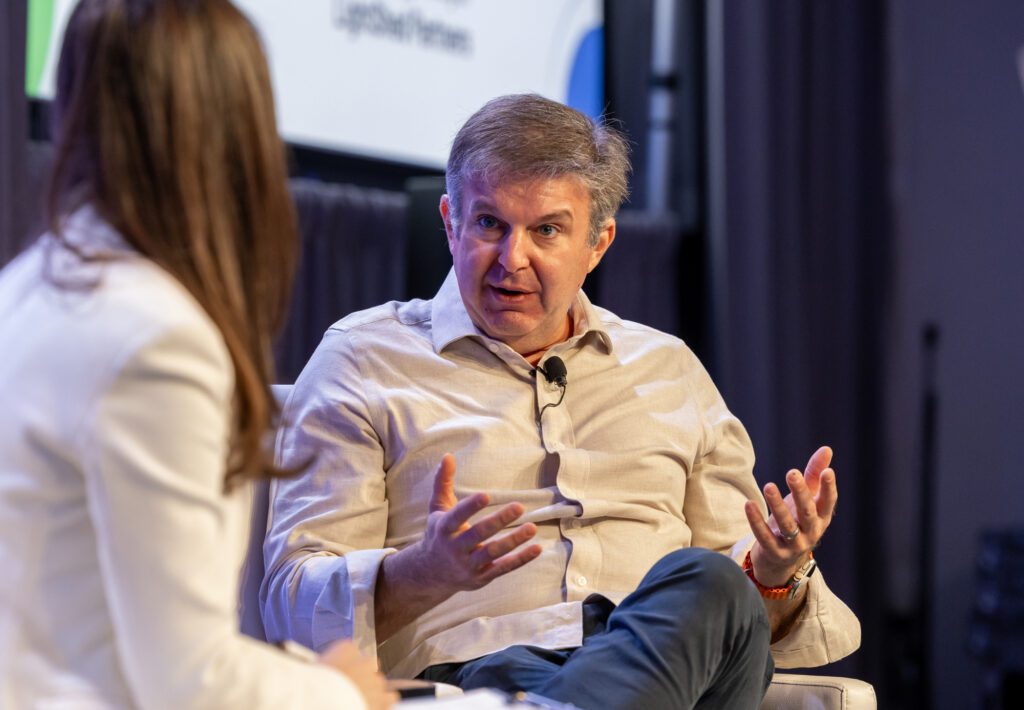
“It was Bob Iger’s fault, and I mean that in the nicest way,” said LightShed Partners Co-Founder Rich Greenfield, speaking at CTV Connect in New York City on Wednesday.
“He was so darn successful on Day One,” Greenfield said.
Disney launched ad-free Disney+ in the US on November 12, 2019. Within 24 hours, it had more than 10 million subscribers. By Q1, that number had doubled and then some.
But something else also happened in Q1: The pandemic hit, and people were stuck at home. Time spent watching streaming content skyrocketed.
Other broadcasters watched this dynamic play out from the sidelines and wanted some of that magic for themselves. NBCU’s Peacock, HBO Max and Paramount+ all launched in short order.

Swimming upstream
But it became pretty clear pretty quickly that operating a successful (which is to say, profitable) streaming service doesn’t take magic; it takes a massive ongoing investment.
Infrastructure, content, licensing, promotion and managing subscriber growth costs billions of dollars.
“Everyone was like, ‘Oh my god, this is how you get your stock to work – you jump into streaming, and so all of these services jump in,” Greenfield said. “And then everyone realizes this is a lot harder.”
Peacock, for example, has lost in the neighborhood of $8 billion since it launched in 2020. Neither Paramount+ nor Disney+ (which now has an ad-supported tier) are profitable. After losing billions, Warner Bros. Discovery managed to turn a modest profit last year – its streaming unit earned $103 million in 2023 – but WBD accomplished this feat through ruthless cost-cutting.
And so it’s not surprising that every major streaming service – including Netflix and Amazon Prime – has introduced advertising as a revenue booster.
The ARPU equation
Back in the day, as in the heyday of linear TV, it was hard to imagine a better business than the traditional multi-channel cable package.
People pay somewhere around $100 a month for access to a bundle of channels, nearly all of which carry roughly 18 minutes of commercials per hour. “That is an advertiser’s dream,” Greenfield said.
But streaming is a different animal. Streaming services can’t rely on ad-free subscriptions alone to reach full market penetration, at least not at a reasonable monthly price point.
“You need advertising to grow the pie,” Greenfield said.
And to make money from advertising, viewers need to spend time actually watching stuff – unlike a linear channel that’s part of a cable package.
If someone subscribes to HBO (as in the linear HBO channel, not the Max streaming service) and only watches one show the entire year – or doesn’t even watch a single minute’s worth of content – that person is still a profitable subscriber.
But for an ad-supported, on-demand streaming service to generate healthy average revenue per user (ARPU), it needs engagement, engagement and more engagement.
Time spent is money earned
Weirdly, though, most streaming platforms aren’t leaning as heavily as they should be into “time spent” as a key metric, like YouTube and Netflix do, Greenfield said.
And the proof is in the pudding, he said, pointing to the Paramount+ Essential plan, which costs $5.99 a month. The ARPU likely isn’t much higher than that.
“They just don’t have enough daily engagement,” Greenfield said, “so they’re not driving enough time spent to have the ad CPM scale up.”
Compare that to Netflix, which has a $6.99 per month ad-supported tier and generates more than $16 in revenue per user a month in the US and Canada.
“That’s because people actually are watching two plus hours every freaking day,” Greenfield said.
If a streaming platform is more focused on subscriber count than time spent – and many are – then they’re doing it wrong.
“Subscriber acquisition is great,” Greenfield said. “But if you don’t get people to use it, does it really matter?”