

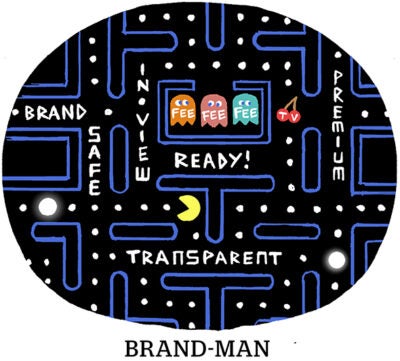
This is a challenging time for grocery-store brands. For example, last month, McKinsey published a report on 18 “arenas of competition” that will define the growth of the economy: It encompasses “Digital advertising,” “Ecommerce,” “Electric vehicles,” “Space,” “Video games” and 13 others. Everything except the manufacture of food, drinks and snacks or household goods. (“Drugs for obesity and related conditions” is a category, though.)
Brands are getting back to basics. They’re rethinking their packaging and trying to figure out how they fit into the new world of retail store shelves. And while they are getting more data-driven, the data is not necessarily for advertising, because brands are trying to connect their physical supply chains and crazy macro-economic events into their business forecasts.

When I say crazy events …
The bizarre vicissitudes of the world can lead to wild knock-on effects for certain businesses or categories.
Candy company advertising was under pressure during Halloween because of a very poor crop season in cocoa farming. Price and advertising are flip sides of the same coin, so if costs are up and there is strong competition on prices, then marketing must work harder to generate the same profitable returns.
Timothy Cofer, CEO of Dr Pepper’s parent company, Keurig Dr Pepper, told investors last month that the soda brand gained sales last quarter from other sugar categories, like chocolate and candy, because those have gotten so expensive that soda can sell itself as a more affordable treat.
Or consider cat litter.
A year ago, Clorox was gobsmacked by a cyberattack that froze its internal systems and payment processing. The company’s Fresh Step litter brand fell way behind on shipments of ingredients and essentially disappeared from store shelves for a spell.
Fast-forward to today, and the cat litter category is a total mess of advertising ROI. Clorox is spending astronomically to regain the market share it lost.
To compete, Church & Dwight, which owns Clorox competitor Arm & Hammer brand, has increased its cat litter “sold-on-deal” rate, or the percent of product sold at discount.
Church & Dwight’s sold-on-deal rates have gone from 15.5% in Q1 to 18% in Q2, and were at 19.5% and still rising this quarter. But the company estimates Clorox’s sold-on-deal rate is more than 40% in the category.
Clorox, in other words, is going absolutely nuts on retail media and in-store trade marketing.
“When you see numbers like 40% to 45% sold-on-deal – no, we’re not going to chase that,” CEO Matthew Farrell told investors last week, when pressed about Clorox’s ad budgets and C&D’s market share losses. Even if Clorox regains market share, “we’re going to be on the sidelines as far as spending a lot of money to chase that number.”
Church & Dwight’s marketing spend as a percent of sales inched up from 11% to 11.5% in the quarter, CFO Rick Dierker said. Which may not sound like much, but for some brands it means additional spend in the low tens of millions of dollars. That is a lot.
The retail race
Ten years ago, the incumbent CPG brands were trying to emulate and understand direct-to-consumer startups. That is no longer the case.
Now, big brands are flaunting their ability to fit into the brick-and-mortar system.
DTC brands are trying to bring more value directly to customers. But they view customers as individuals who purchase their products or engage with the brand online. For Coca-Cola, Pepsi, Kraft Heinz and others, “customers” are the retail businesses.
“In the past 12 months, we created $11 billion in incremental retail sales for customers, which is more than double the next five closest beverage companies combined,” touted Coca-Cola CEO James Quincey during his recent earnings call.
What he means is that Coca-Cola invested heavily in new cold drink equipment for retailers to place in their stores.
And other brands have also touted their ability to meet retailers’ needs.
During earnings calls, Kraft Heinz and Pepsi execs discussed their ability to adapt product packaging on the fly to meet the needs of retail partners. Next year, Capri-Sun will add large bottles, rather than its recognizable pouches, which helps with stocking in club stores like Costco.
Rather than chase the dream of data-driven advertising and ecommerce, big brands are leaning into the things they know how to do, which small brands really cannot manage.
The new shopper keywords
Fitting into retail means more than just real-time feedback between factories, warehouses and in-store shopping trends. CPGs must also adjust to the healthy eating vernacular that’s driving grocery sales, by which I mean the war on sugar and new ideas of health.
This is why ice creams that have always included protein now tout protein on the carton.
As another example, the trademark Coca-Cola products grew its overall sales volume in Q3, Quincey said. But within that, original Coke was flat to slightly down, while sugar-free Coke Zero grew by double digits and Diet Coke grew modestly.
Pepsi is putting big spend and R&D behind what it calls its “Permissible Portfolio.” The permissible brands are low-sodium or low-sugar snack lines, such as PopCorners, SunChips and Smartfood, which are also not fried or made from potatoes.
“Clearly, the consumer has been moving in some parts of the world towards looking for more permissible snacks or going into more unstructured meals,” said PepsiCo CEO Ramon Laguarta last month.
What he means is that people are eating, say, Sabra hummus and Tostitos chips, two Pepsi-owned brands, and a banana (his example), rather than a traditional lunch with, perhaps, a bag of Doritos or Fritos, Pepsi snacks that have had tough sales seasons.
“Over time, when the consumer gets a little more healthy and the business accelerates, we can put a little more emphasis on managing the margin,” Pepsi CFO Jamie Caulfield told one investor who pressed about the declining profit margin for Frito-Lay (decidedly not part of Permissible Portfolio).
Caulfield is using “healthy” in the macro-economic term of art sense of having disposable income (thus “more healthy,” and not the grammatically correct “healthier”).
And CPG brands are only going to see their health improve if they relearn how to succeed in physical store shelves.






