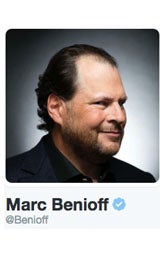
 Forget ecom platform Demandware and data management platform Krux. Investors only want to know why in the world Salesforce CEO Marc Benioff has any interest in Twitter.
The pounding Salesforce’s stock has taken since Benioff expressed interest certainly reflects their skepticism. So while the little blue bird hasn’t been an explicit presence in this year’s annual Dreamforce gala, it certainly has haunted San Francisco’s Moscone Center during the shindig.
Benioff has since thrown cold water on the possibility of an acquisition, noting Twitter’s “very severe challenges.” Salesforce would ultimately need to fix the consumer-facing Twitter product, whose growth rates have plateaued over the past few years.
“How long is Twitter going to last?” said Mark Lush, a principal at Deloitte Digital. “Think of it from a tools perspective. The average consumer is so fickle. Instagram was the cat’s meow and it’s still very popular, but Snapchat came along and a whole demographic moved to it.”
Benioff hasn’t clearly articulated why Salesforce should own Twitter. Many stakeholders initially assumed he wanted immediate access to Twitter’s data – the same reason they assumed he grabbed at LinkedIn, which eventually went to Microsoft. (Benioff’s grumbling that Microsoft might hoard LinkedIn’s data assets seemed to underscore Salesforce’s interest in data access.)

Yet during an investors meeting Wednesday that occurred after his Dreamforce keynote presentation, Benioff said his interest in LinkedIn wasn’t data-related. The same, he implied, was true of Salesforce’s interest in Twitter (though he did not refer to the company by name).
“Based on his very indirect comments, because he couldn’t address it specifically, he sees an undervalued asset [with which] he thinks he can maximize value,” said Brian Wieser, senior research analyst at Pivotal Research.
Benioff has publicly stated that Twitter is an “unpolished jewel” and he reiterated those comments to investors Wednesday.
“He made it clear his interest in LinkedIn was financial,” Wieser said. “It was not about the strategic connection.” In other words, LinkedIn was available at a reasonable price.
Wieser continued: “And so it leads one to conclude that comments about Twitter being a ‘jewel’ – that [Salesforce] just thinks they can provide a better home for it. The synergies may only show up after the fact.”
This lack of clarity worries investors, who were sold on Salesforce’s road map of being a cloud-based software provider. Its acquisitions of ecom platform Demandware and data management platform Krux fill genuine holes in the Salesforce portfolio.
If Twitter were a strategic play, acquiring its data might align with Salesforce’s motivation for buying Krux. It would also be consistent with acquisitions made by rival Oracle, which bought Datalogix, BlueKai, Crosswise and AddThis to build out a data cloud service.
There might also be an analogy with computing giant IBM’s acquisition of The Weather Co., which like Twitter has a consumer-facing media business with proprietary data.
Ad Tech Assets
Twitter also has ad tech products that could fit into either Salesforce Marketing Cloud or its new, Demandware-powered Commerce Cloud. Those products include a demand-side business (TellApart), a mobile ad exchange (MoPub) and mobile purchasing platform TapCommerce.
One can envision synergies for these components with Krux as well as Salesforce’s own assets like social media marketing platform Buddy Media and social listening tool Radian6.
Salesforce, however, has not shown an interest in participating in open ad exchanges before – and there’s no indication that it would want to start now by inheriting MoPub.
TellApart and TapCommerce make more sense. TellApart has cross-device, targeting and attribution capabilities that could slot Marketing Cloud. (Oracle acquired Crosswise to provide cross-device ID matching.) TapCommerce could fit with Commerce Cloud.
All of these assumptions are based on Salesforce having a Twitter strategy. And Benioff’s comments to investors indicate there isn’t one.
While many investors questioned whether Salesforce, with a market cap of $46.09 billion and $1.72 billion in total cash during its Q2 2017, could even afford Twitter – expected to go for $20 billion – Recode recently indicated that Disney and Google were not going to bid.
Would a dip in Twitter’s price make that “diamond in the rough,” as Benioff called it, shine even more?