Ads To Burn After Reading
Pixels attached to articles explaining a recent health diagnosis – without consent – led Healthline to a record $1.55 million fine for violating CCPA. Plus: the new AI contract.
Over the past few years, sell-side curation has gained popularity as a way for advertisers to target high-quality publishers. Companies like OpenX are expanding their toolkits to support advertisers as well as publishers.
Add digital health and wellness publisher Healthline to the growing list of companies hit with fines under California’s privacy law.
A UK-based early-stage startup called Paapi, which just closed its pre-seed funding round last month, is building a platform to help advertisers with privacy-safe ad measurement.
Critics say the FTC’s deal with OMG/IPG prohibits agency practices that don’t exist. And it distracts from legitimate concerns about brand safety news blocking and principal media.
Whatever your take on the FTC’s oddly conditional green light for the Omnicom/IPG merger, one thing’s clear: The agency is being more active than expected.
Alliant will integrate AnalyticsIQ’s audience modeling platform, which is based on user surveys and studies of health, wellness and cognitive psychology.
In a world where privacy regulations are tightening and third-party cookies are increasingly unreliable, first-party data has emerged as a cornerstone of modern marketing strategy.
The FTC puts some odd stipulations on Omnicom-IPG; influencer marketing is the new normal; Google is cutting its smart TV group.
But publishers have more power than they think to authenticate their audiences – they’ve just gotta learn how to wield it.
Google released a proposal for a Chrome feature called script blocking as part of a broader effort to mitigate API misuse for broader reidentification. In short: It’s a crackdown on fingerprinting in Incognito mode.
Going For The Cinematic Effect; Do The Youngs Shop Google?; X Marks The Spot
Even the CMA doesn’t seem to care about the Privacy Sandbox anymore. On Friday, it announced that it’s begun the process of “releasing” Google from its Sandbox commitments.
Life360, a popular family safety and tracking app, announced its first location-based ad targeting solution, called Place Ads, and a foot-traffic analytics product named Uplift that measures store visitation.
Open Intelligence is WPP’s Media’s new solution to help advertisers make sense of their data and use it in more ways, with a longer-term goal of decentralizing data.
AI-generated mystery pages are appearing on brand sites; Amazon Prime Video doubles its ad load; and bipartisan efforts to protect kids online get a new partisan focus under the Trump admin.
Marketers having to justify their budgets is nothing new, but macroeconomic anxiety is making the stakes feel higher.
Despite all the cookie drama, companies haven’t completely abandoned the Chrome Privacy Sandbox, and BU marketing professor Garrett Johnson has the receipts to prove it.
Can the IAB Tech Lab’s Trusted Server initiative really help restore publishers’ ownership of monetization and wrestle back control from Big Tech and walled gardens?
Google’s pivot on IP addresses shows it fears competition; the FTC investigates media watchdogs for advising brands not to spend on X; and Mondelez accuses Aldi of copying its snacks.
Michael Komasinski, Criteo’s newly-minted CEO, shares his vision for the company – and swears that Criteo doesn’t regret its huge investment in testing the Chrome Privacy Sandbox.
The modern marketing landscape is being rewritten in near real time. While economic uncertainty may tempt brands to retreat into the comfort of walled gardens, the truth is more nuanced, especially regarding data and identity solutions.
CTV ad platform MNTN has gone public; last week, the FTC dismissed a lawsuit brought against PepsiCo; the new US budget bill might ban state regulation of AI.
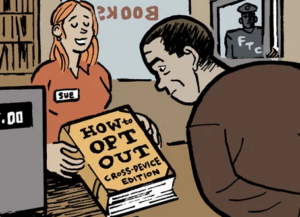
Enjoy this weekly comic from AdExchanger.com that highlights the digital advertising ecosystem …
The era of fragmented, adversarial ad tech is winding down. A new paradigm is emerging defined by AI-first, end-to-end platforms and collaboration among buyers and sellers.
There’s a reason ad tech is no longer in a position to self regulate. Somewhere along the way, companies forgot to respect their consumers and so regulators stepped in.
The DOJ is proposing that Google should give rival ad exchanges and ad servers real-time access to bidding data from AdX – and Google agrees.
AdExchanger spoke to a number of programmatic leaders who testified in the DOJ’s Google antitrust trial last September.
Google isn’t a regulator. From an attorney’s point of view, its decrees don’t carry the force of law, and that’s what lawyers are concerned with: the law.
Google’s SSP and ad server businesses have been ruled monopolies. And Google Chrome isn’t going to change its third-party cookie opt-ins, further preserving third-party cookies. Go inside this momentous news.