In early September, Google agreed to settle a class-action lawsuit in California – brought-over claims that it shares personal information with third parties without consent – by promising to build a tool that stops any personal data from leaking into ad auctions.
In short, it’s like an off switch for programmatic personalization.
Huge deal, right? It begs the question why barely anyone’s talking about this.

The RTB Control, as it’s being called, would apply to Google account holders and remove all tracking data from bid requests, including pseudonymous identifiers. That means no cookies, IP addresses, device IDs, encrypted Google user IDs, user agent details or any other identifying or potentially identifying information. [Read the full proposed settlement here.]
It’s a bit like that scene in a “A Christmas Story” after the Bumpus hounds ravage a turkey dinner, and the family is standing around their broken, empty kitchen table as adult Ralphie laments in voice-over: “No turkey! No turkey sandwiches! No turkey salad! No turkey gravy! Turkey hash! Turkey a la king! Or gallons or turkey soup! Gone, all gone!”
No cookie matching, no data sharing, no targeting through RTB for personalized advertising – gone, all gone!
Cold turkey
Then again, this mechanism doesn’t exist yet; it’s not clear exactly how it would work, it’s an opt out – meaning users with Google accounts would have to manually turn it on to opt out of data sharing – and the settlement itself hasn’t been finalized.
The earliest possible date for a court hearing to approve the settlement is January 13, 2026.
With all of that in mind, it’s not surprising that this thing is flying under the radar, said privacy attorney Alan Chapell.
Yes, an RTB Control would essentially be a “kill switch” for programmatic, he said, but it’s hard to prioritize something when the details are vague, the timeline feels far off and people are overwhelmed with more immediate challenges.
Not to mention fatigue from constant legal actions and regulatory changes.
“It’s like, ‘Well, maybe we’ll be screwed over the long term or whatever, but, boy, if I can just get through this quarter,’” said Chapell, who’s also a regular contributor to Marketecture’s Monopoly Report. “There’s that mindset, plus, when it comes to privacy, sometimes I can barely get people to pay attention at all.”
But the opt-out factor is also a big reason why this proposed mechanism isn’t capturing much attention. History has shown that opt-out controls rarely spur widespread action. Most people simply leave things as they are. The inertia of defaults is real.
“We’ve had 20 years of opt-outs that didn’t really amount to much,” Chapell said, “and that further dampens any sense of urgency.”
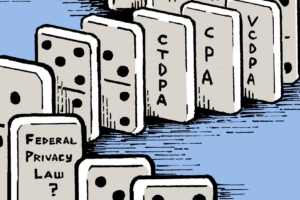
Domino effect?
Still, the settlement could set a precedent by providing a template that regulators, lawmakers and privacy advocates point to when pushing for similar controls elsewhere, both in the US and abroad.
“If it does get codified, I promise you that some state and/or the European Union is going to also insist on this capability,” Chapell said. “Everybody is constantly borrowing from each other in these circles.”
So, TBD on what an RTB Control could mean for the wider programmatic ecosystem.
The more immediate question is what it means for Google, which brings up a key caveat: Google rarely gives ground unless it’s confident the ground isn’t all that valuable.
If this proposed mechanism makes Google’s RTB ecosystem less efficient, it could open the door for rivals and spark new waves of innovation, according to a privacy lawyer who shared thoughts with AdExchanger anonymously because their firm does business with a Google subsidiary.
“But it’s difficult to think Google would agree to this if that were a legitimate possibility,” they said.
Chapell was even more pointed: “Google has been brilliant for a long time at creating scenarios that are challenging as hell for everybody else, but they almost always win regardless of the ultimate outcome – I mean, they won in the Sandbox.”
 The official line
But what does Google itself have to say about all this?
Despite Google having agreed to the settlement, a Google spokesperson shared this statement with AdExchanger: “We do not sell or share personal data and we already have the strictest real-time bidding restrictions in the industry. We are pleased to put this case behind us.”
According to Google, users already have lots of ways to manage their privacy settings, and Google is planning to expand those options in the coming months.
RTB data can only be used for advertising, Google told AdExchanger. It’s never sold or shared with unrelated third parties, and Google regularly conducts audits to make sure everyone’s complying with its policies.
Google also emphasized it doesn’t include any personally identifiable information in bid requests or share sensitive details, like health, race, political views or precise location. What does get shared are things like page URL, app ID and general location based on a broad group of users.
So, uh, guess there’s nothing to see here, folks. Google says everything is already under (RTB) Control.
🙏 Thanks for reading! I’m pretty sure this cat is opting out – of everything. As always, feel free to drop me a line at allison@adexchanger.com with any comments or feedback.