

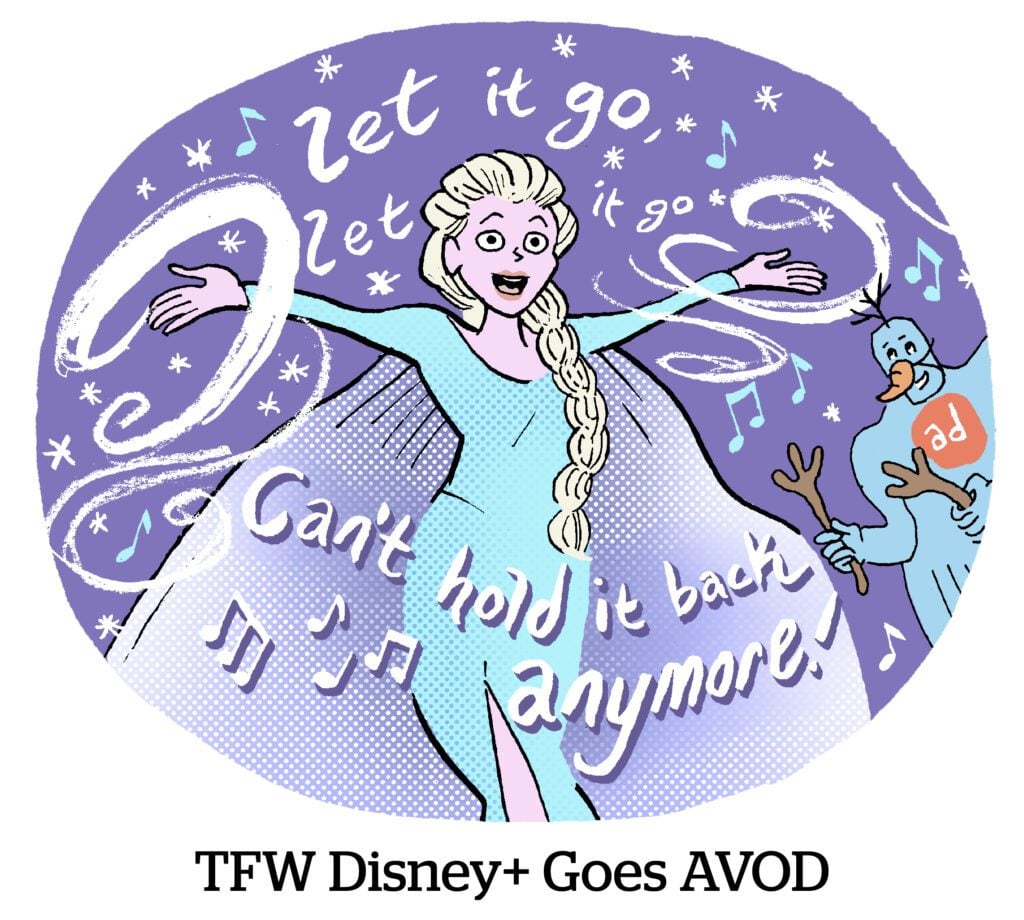
Disney is celebrating the first birthday of ad-supported Disney+ with a new slate of targeting and measurement options for advertisers.
On Friday, Disney announced that, in addition to making Disney+ inventory biddable through private marketplaces, its first-party data graph will be available for ad targeting on Disney+ starting in November.
Previously, Disney+ inventory had only been available directly or through programmatic guaranteed deals.
But the subscriber base on ad-supported Disney+ is now big enough to justify investments in better targeting, measurement and programmatic availability, said Josh Mattison, SVP of revenue management and operations for Disney Advertising.

The rate of viewer adoption for Disney+ with ads “has steadily grown throughout the year,” Mattison said. Nearly 50% of new Disney+ subscribers opt for the ad-supported option. (For reference, that number is only 30% for Netflix.)
Time spent watching Disney+ has also grown for the ad tier – up by 35% since the spring, Mattison said.
Now, he said, Disney+ with ads has “large enough audience pools to start introducing our next layer of targeting.”
On target
Recent updates to Disney’s ad products are all part of the company’s plan to “make sure Disney+ has parity with everything we’re doing on Hulu,” Mattison said.
On Wednesday, for example, to support self-serve programmatic, Disney announced the addition of its first-party audience graph to Disney Campaign Manager, which it rebranded from Hulu Ad Manager at the beginning of the year.
Disney Advertising President Rita Ferro first hinted at these moves ahead of Disney’s annual Tech & Data Showcase in January. Since then, Disney has been making steady improvements to Disney+ targeting.
When Disney+ with ads first launched in December, advertisers could only target based on age group. Over the summer, Disney+ introduced geotargeting and age/gender demos for targeting, Mattison said.
Now, Disney’s first-party data is also available for ad targeting starting next month. The audience graph currently has 235 million unique viewers, 110 million households and more than 2,000 interest- and behavior-based audience segments.
Buyers can use this data to target more specific audience segments on Disney+, such as viewers who are in market for a new car, for example.
But why did it take a year for Disney to implement its own audience graph?
The reason was not because the tech wasn’t there, Mattison said. (Disney and Hulu are both powered by Disney’s Unified Ad Platform.)
Rather, the company wanted to wait until the ad-supported Disney+ audience base was large enough to support more granular targeting.
Now that Disney+ with ads has wide enough scale, Disney is making that inventory biddable within the 30 DSPs that partner with the platform, which include The Trade Desk, Google’s DV360 and Viant.
A measured approach
And with more precise targeting comes the need for better measurement.
Disney+ will also now offer reach and frequency measurement based on data from iSpot and Data Plus Math, in addition to outcomes-based measurement from Innovid, Cuebiq and Foursquare. Disney already has measurement integrations with VideoAmp and Samba TV.
“We’re focused on lower-funnel attribution to [better] support performance-oriented advertisers,” Mattison said, including with metrics such as footfall traffic (from Cuebiq and Foursquare) and conversions on both web and app (from Innovid).
But nearly all TV buyers look for basic reach and frequency counts, which is why Disney works with a wide array of measurement providers to address advertiser needs for metrics throughout the purchase funnel, Mattison said.
According to Mattison, Disney is optimistic that advertiser demand will “grow exponentially” as a result of the new upgrades to Disney+ targeting, measurement and programmatic buying. Mattison said Disney+ now has twice as many brand clients as it did when it first launched its ad tier last year.
The more targeting effectiveness advertisers get, Mattison said, the more willing they are to spend on streaming.







